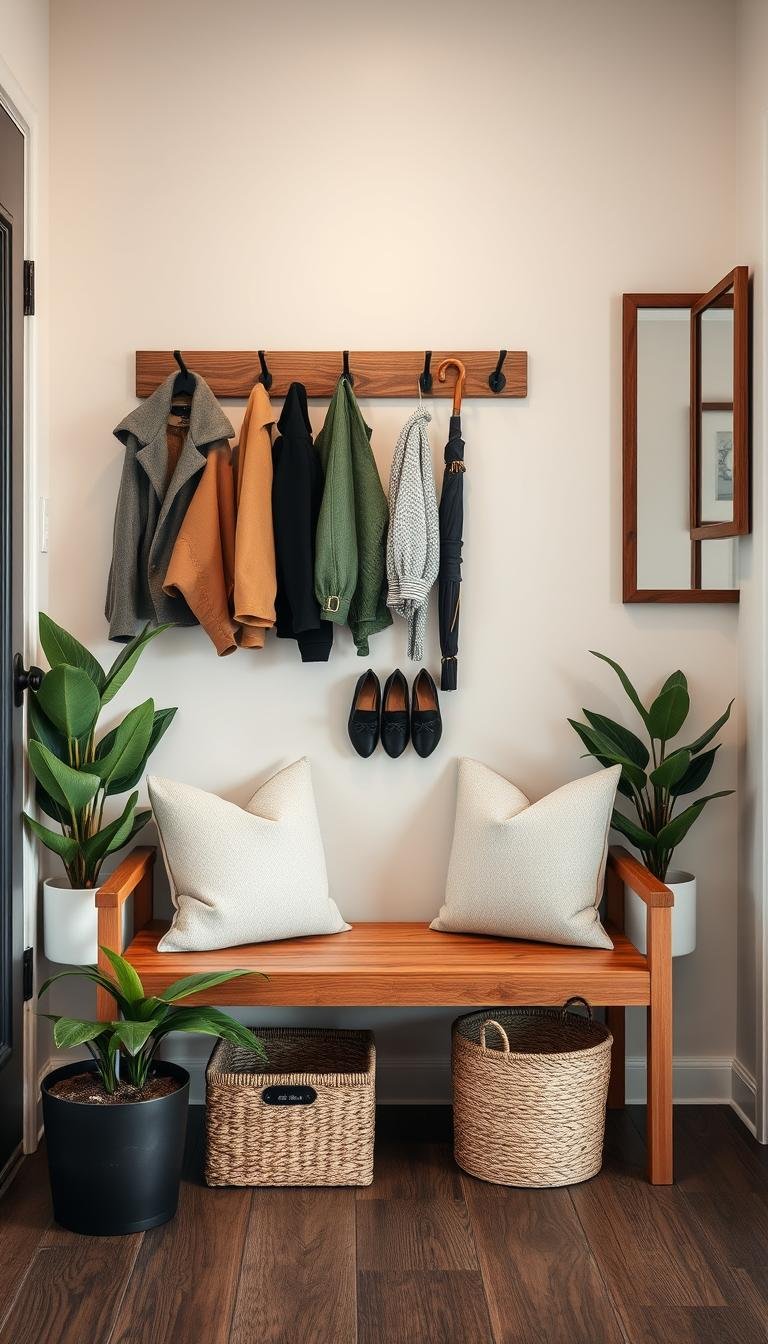
Daily entry clutter—lost keys, mail piles, shoes in the living room—creates small but constant friction. This guide frames the problem and offers clear, renter-friendly solutions that save time and calm the household flow.
A good drop spot is simple: a tray or shelf with hooks, a basket, and a shoe containment plan placed where people already set things down. The article previews practical modules—small essentials tray, hooks for bags and coats, shoe containment, and paper control—so readers can mix and match for their space.
Readers will get specific recommendations by household type: renters, small apartments, families with kids, pet owners, and commuters. Each option will note who it suits, what problem it solves, and what to compare before buying, such as size, mounting, safety, and cleanability.
This guide starts with routines and traffic flow, not decor alone, so solutions match habits and actually reduce daily friction.
Key Takeaways
- Focus on traffic flow first; place the solution where people already set items down.
- Mix modular elements—tray, hooks, shoe storage, and mail control—for custom setups.
- Recommendations are tailored for renters, small spaces, families, and commuters.
- Each pick will include who it’s for, problems solved, and buying comparisons.
- Freestanding vs wall-mounted choices depend on space, mounting limits, and safety.
What a drop zone is and why it works in real homes
A clear, planned landing area at the threshold stops the usual scramble for keys and phones. In plain terms, a drop zone is a dedicated place near the door where people can set essentials down quickly, efficiently, and safely.
It works because it matches real behavior. Keys on the kitchen counter become a small tray. Backpacks on the floor become a hook or basket. Mail piles become a shallow file or single-slot tray.
A quick functional test
If someone can walk in with full hands and still know where to set a phone, wallet, or keys, the area passes. If not, the design needs a true landing surface — a shelf, tray, or shallow bin.
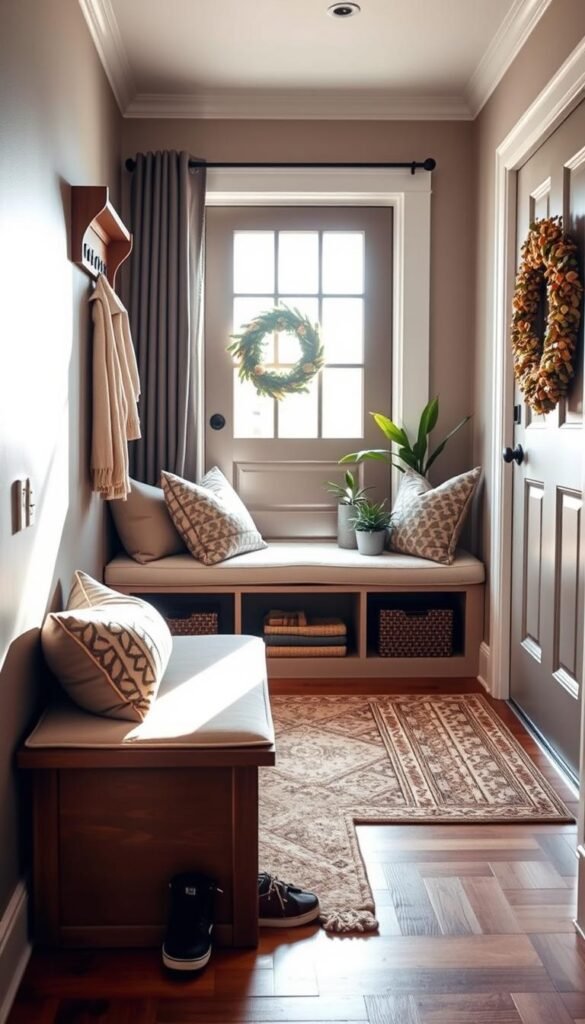
Mudroom vs. a focused landing spot
A mudroom often stores coats and shoes. A proper landing spot includes an intentional surface for urgent items like documents to return or time-sensitive mail. Open storage is fast and visible. Closed storage hides clutter but can reduce follow-through.
„A reliable landing spot keeps everyday items in one easy-to-find place.“
- Design for the natural path in and out, even in a narrow entryway.
- Choose open vs closed depending on visibility needs and neatness.
- Prioritize a stable landing surface for small essentials.
Start with your “drop list” to design a drop zone that actually gets used
Start by listing what actually lands in your hands when you walk through the door. This short audit keeps the design practical.

Everyday essentials
Keys, wallet, sunglasses, badge, and headphones need a shallow tray or small basket for quick grab-and-go. Specify tray depth (1–2 inches) and a fixed spot rule to avoid last-minute searches.
Family traffic
Count backpacks and lunch bags. Note how many hooks and the bin size for lunch gear. For a family of four, plan 4 hooks and a 12–15″ basket per daypack.
Home management & pet gear
Give time-sensitive mail and returns their own labeled slot to prevent loss. For pet and messy items, choose wipeable bins and a towel hook near the door to catch spills.
„A clearly sized list turns a decorative setup into a reliable habit.“
| Category | Must-Have | Size/Count | Material |
|---|---|---|---|
| Everyday essentials | Shallow tray | 1 tray, 1–2″ deep | Metal or plastic |
| Family gear | Hooks + basket | Hooks: per person; basket: 12–15″ | Wood/metal + fabric bin |
| Home management | Paper sorter | 3–5 slots (urgent slot) | Wood or plastic |
| Pet & messy items | Wipeable bin | One large bin; towel hook | Plastic or coated fabric |
Where to put your drop zone for the least friction
Choose a landing area that matches how people already move through your home. The right placement makes a setup usable every day, not just pretty on a tour.
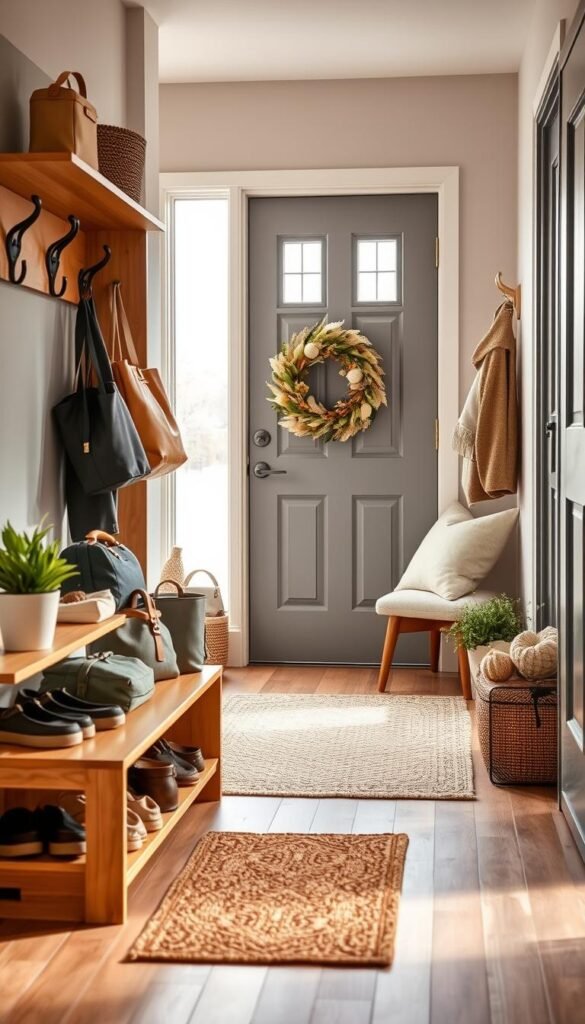
Just inside the front door
Why it works: Most families pause here, so keys and mail land in one place. Keep a shallow tray or slim console for fast access.
Front-door checklist: Keep 36″ walkway clearance, do not block the door swing, and provide a quick landing surface for keys and mail.
Mudroom for messy gear
Use this room to contain boots, coats, and pet towels. Combine hooks, a wipeable bench, and a durable mat.
Garage and kitchen entries
Garage entrances are ideal for wet-weather gear; choose racks that allow drip control. If everyone actually comes through the kitchen or a rear hallway, place paper control and small-item storage there.
Laundry corner conversions
Small homes can convert an unused corner with vertical organizers, hooks, and a narrow bin to create low-cost, renter-friendly storage.
| Location | Why it fits | Low-friction products | Renter notes |
|---|---|---|---|
| Front door | High traffic; fast grab-and-go | Console table, shallow tray, wall hooks | Slim console or adhesive hooks to avoid drilling |
| Mudroom | Contains mess and seasonal gear | Bench with cubbies, wipeable bin, heavy-duty hooks | Freestanding bench if wall mounting not allowed |
| Garage | Good for muddy shoes and pet towels | Vertical organizer, boot tray, durable hooks | Weatherproof racks and removable mats |
| Laundry corner / hall | Turns unused space into useful storage | Vertical shelf, baskets, over-the-door hooks | Use adhesive hooks and slim shelves |
Small-space and renter-friendly entryway drop zones that won’t damage walls
When walls are off-limits, clever freestanding and over-the-door systems save space and sanity. These solutions focus on stability, footprint, and removability so renters can keep the place intact.
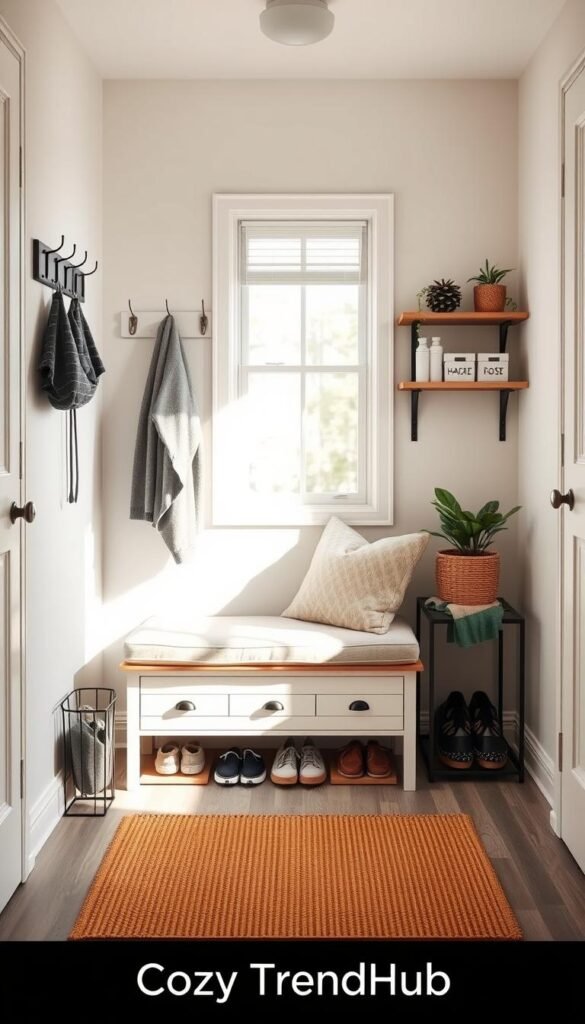
Freestanding coat racks suit singles and couples with light coat volume. They avoid drilling but must be stable. Check base diameter and tipping risk before buying.
Console tables with baskets
A slim console table creates a quick landing and hides clutter with baskets underneath. Measure console depth and basket height so it won’t block a hallway or door swing.
Adhesive hooks and over-the-door racks
Removable strips and adhesive hooks work for lightweight items. Note weight limits and paint sensitivity. Over-the-door racks add vertical storage for cleaning gear or grab-and-go items when floor space is tight.
- Buying checklist: footprint depth, stability, weight limits, removability.
- Reserve heavy backpacks for sturdier stands or a low console.
- Consider cork tiles on removable strips for notes and masks.
| Product | Good for | Key specs | Pros / Cons |
|---|---|---|---|
| Freestanding coat rack | Renters with few coats | Base width 18–24″, 3–6 hooks | Pro: no drill; Con: can tip if narrow base |
| Slim console + baskets | Narrow hallways | Depth 10–14″, basket height 8–12″ | Pro: landing + hidden storage; Con: needs 30–36″ walkway |
| Adhesive hooks / strips | Temporary needs | Weight limit 3–10 lb each | Pro: no wall damage; Con: paint risk, low load |
| Over-the-door rack | No wall space | Door clearance 1–2″, vertical slots | Pro: vertical storage; Con: may block trim or peephole |
For seasonal styling ideas that pair well with renter solutions, see spring entryway decor.
Best entry drop zone solutions for real-life clutter
Real households need systems that tame daily clutter without extra effort. This section outlines three high-performing solutions and which problems each solves.
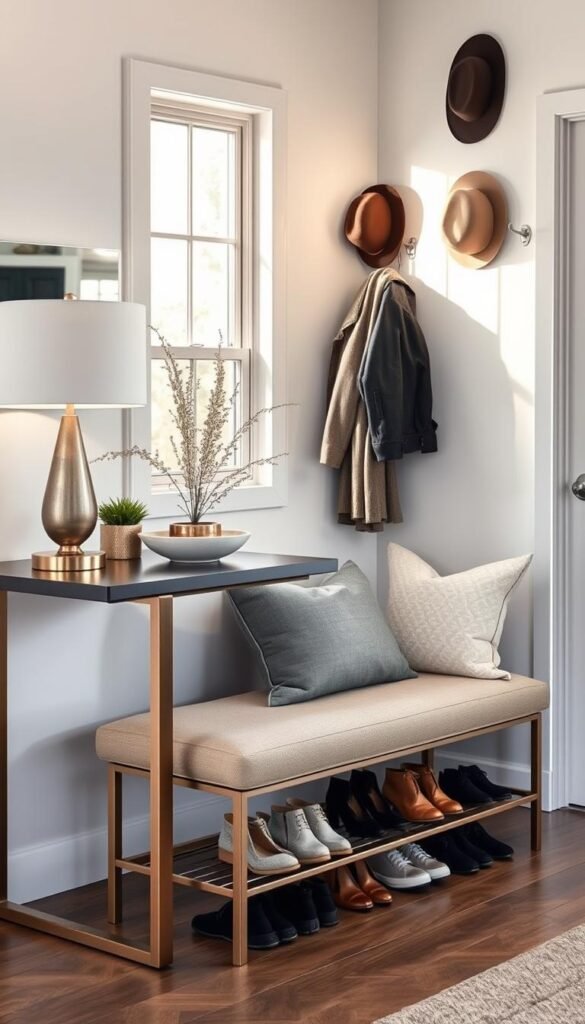
One-wall organizer systems
Best for: homes that want a clean, semi-custom look.
Combine open cubbies for daily grab items with closed cabinets to hide overflow. Mounting trim around units creates a built-in feel without a full remodel.
Pros: high capacity, polished appearance, mixed storage.
Cons: wall-mounted install and higher cost; open cubbies show clutter if not managed.
Bench-and-cubby combos
Best for: shoe-heavy households and families with kids.
Sit-and-store designs encourage shoe removal and place footwear immediately into cubbies beneath the seat. Choose a bench depth that fits your walkway.
Pros: encourages routine, large shoe capacity, integrated bench seating.
Cons: needs deeper footprint; some styles limit legroom for full-size shoes.
Wall hooks at multiple heights
Best for: mixed-age families who need fast access.
Install hooks at adult, child, and low bag height to make hanging simple for everyone. Use heavy-duty anchors for durability.
Pros: low cost, minimal footprint, flexible placement.
Cons: visible items can look messy; proper spacing and mounting are essential.
„Accessibility for all ages is what makes routines stick.“
| System | Footprint | Capacity | Install difficulty | Renter suitability | Open vs closed |
|---|---|---|---|---|---|
| One-wall organizer | Medium–Large (wall length) | High | Wall-mounted, moderate–high | Good with freestanding variants | Mixed (cubbies + cabinets) |
| Bench + cubbies | Medium (depth 14–20″) | Medium–High (shoes + bins) | Low–moderate (freestanding) | Very renter-friendly | Mostly open (add baskets for concealment) |
| Multi-height hooks | Small | Low–Medium (jackets, bags) | Low (anchors required) | Excellent with adhesive options | Open |
Keys, wallets, and sunglasses: the “small essentials” zone that prevents daily delays
Small, deliberate spots for keys and wallets cut frantic searches to seconds. The essentials area is the highest-ROI part of a drop zone because it directly prevents late departures.
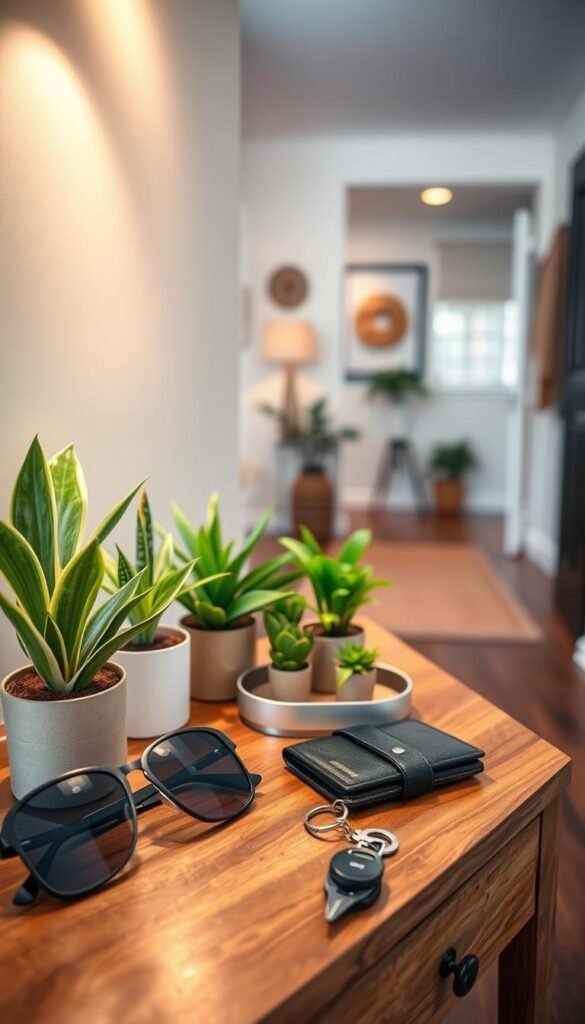
Open trays and small baskets for quick grab-and-go
Open trays and shallow baskets help people who need visibility and speed. The rule here is simple: see it = remember it. Choose a tray with a low lip so keys and sunglasses rest visibly.
Wall-mounted mini cubbies for tight footprints
Wall-mounted mini cubbies free up console space. They work well in narrow halls and keep essentials off the floor. Pick shallow shelves placed at natural hand level near the door.
When closed drawers are better than open bowls (and when they aren’t)
Drawers hide visual clutter and tame many small items. They suit households sensitive to messy surfaces.
But drawers can make forgetful people worse if items are out of sight. For those users, open trays or labeled baskets tend to improve consistency.
- Buying notes: lip height, easy-to-clean finishes, and mounting stability.
- Placement: hand level near the door for fastest transfer.
| Product | Quick “best for” | Pros |
|---|---|---|
| Shallow tray | visibility & speed | See items; fast grab |
| Wall cubby / shelf | tight footprints | Saves floor space; easy reach |
| Small drawer insert | visual clutter sensitivity | Hides mess; organized compartments |
Shoe storage that keeps floors cleaner (especially in wet seasons)
Wet weather makes shoe clutter a cleaning task, not a style choice. A clear, designated place for shoes keeps mud, salt, and meltwater off floors. Treat shoe control as a cleanliness priority that shifts behavior day to day.
Shoe drop-off rules that actually stick:
- Make the spot obvious — visible and close to the door.
- Make it easy — low effort to remove and store footwear.
- Match capacity — one slot per regular pair used that day.
Drip-control hacks for rain and snow
Boot trays are ideal for heavy wet seasons. They hold slush and salt and are easy to hose out. For budget shoppers, place a metal cooling rack on a large plastic tray to lift shoes above pooled water and speed drying.
Who each option fits:
- Boot trays — heavy winter climates, pet owners.
- Shoe racks with slatted shelves — families with many pairs, fast airflow.
- Cooling-rack-on-tray — budget solution for occasional storms.
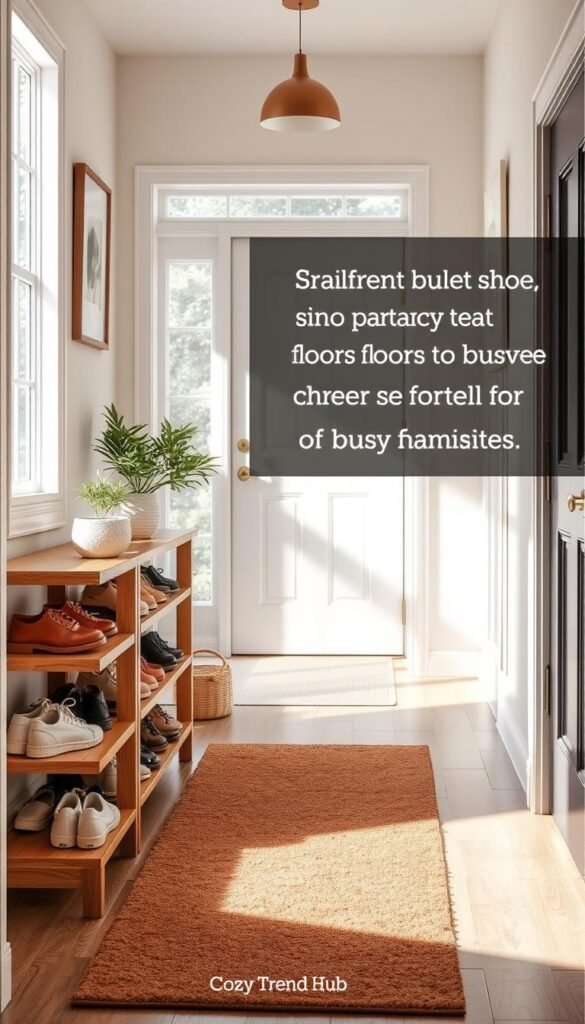
Open cubbies vs. lidded bins: pros and cons
Open cubbies are quick to use and allow shoes to breathe. They work well for households that need speed and visibility.
Lidded bins hide mess and stack neatly. They are good for seasonal storage, but lids add an extra step and can trap odor if shoes stay damp.
| Option | Pros | Cons | Good for |
|---|---|---|---|
| Open cubbies | Fast access; ventilation | Shows clutter | High-traffic families |
| Lidded bins | Conceals mess; stacks | More handling; potential odor | Seasonal storage; neat aesthetics |
| Boot tray / slatted rack | Containment for wet footwear | Needs cleaning | Wet climates; mudrooms |
Buying considerations: choose tray size to hold your typical shoe count, pick an edge height that contains meltwater, and confirm the system pairs with a bench for sit-and-store behavior. For practical organization ideas and product guidance, see entryway organization.
„A visible, easy shoe place reduces tracking and makes cleanup simple.“
Mail, school papers, and to-dos: create an entryway command center
Paper often sneaks from the door into counters and becomes a daily drag; a focused command center stops that flow. A small wall setup saves countertop space and makes time-sensitive mail and forms impossible to lose.
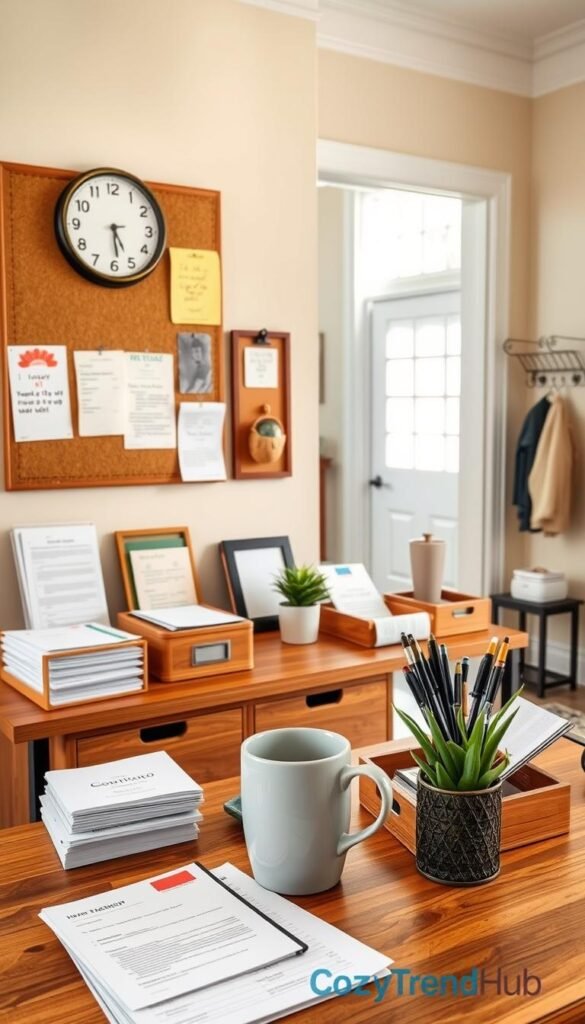
Bulletin boards and cork tiles for calendars and permission slips
Who it helps: families, students, and WFH households that need visible reminders.
Pin calendars, permission slips, and quick notes to a large bulletin board or modular cork tiles. For renters, use self-adhesive strips so the wall stays intact.
Wall-mounted file folders and vertical dividers to stop paper piles
Use labeled wall folders or vertical dividers to sort incoming mail, schoolwork, and bills. Pick a model with 3–6 slots depending on household size.
Advantages: clear capacity, fast sorting, fewer loose stacks on the shelf or counter.
Message-center add-ons: dry-erase and magnetic boards
Add a magnetic strip or small dry-erase board for quick updates and grocery notes. Keep a marker and eraser in a mounted cup so the tool stays handy.
- Pros/cons: boards increase visibility but can look busy; folders need labeling discipline.
- Features to prioritize: slot count, board size, mounting method (adhesive vs anchor), and expandability.
- Quick setup tip: combine a cork section with 4 file slots and a 12″x12″ dry-erase square for a compact command center.
| Feature | Good for | Mounting | Expandability |
|---|---|---|---|
| Large bulletin board | visible reminders | anchors or adhesive strips | easy to add cork tiles |
| Wall file folders (4–6 slots) | high mail/school volume | anchors recommended | modular slot add-ons |
| Magnetic / dry-erase panel | quick notes & schedules | adhesive or small anchors | can pair with file units |
„A visible command center turns paper into a weekly routine instead of a daily scramble.“
Baskets, labels, and “assigned spots” that make drop zones work for families
Assigned spots cut daily friction by making choices automatic for everyone who comes through the door. One basket per person keeps gear corralled and reduces countertop creep. Typical contents: hats, gloves, school forms, sunglasses, and small sports items.
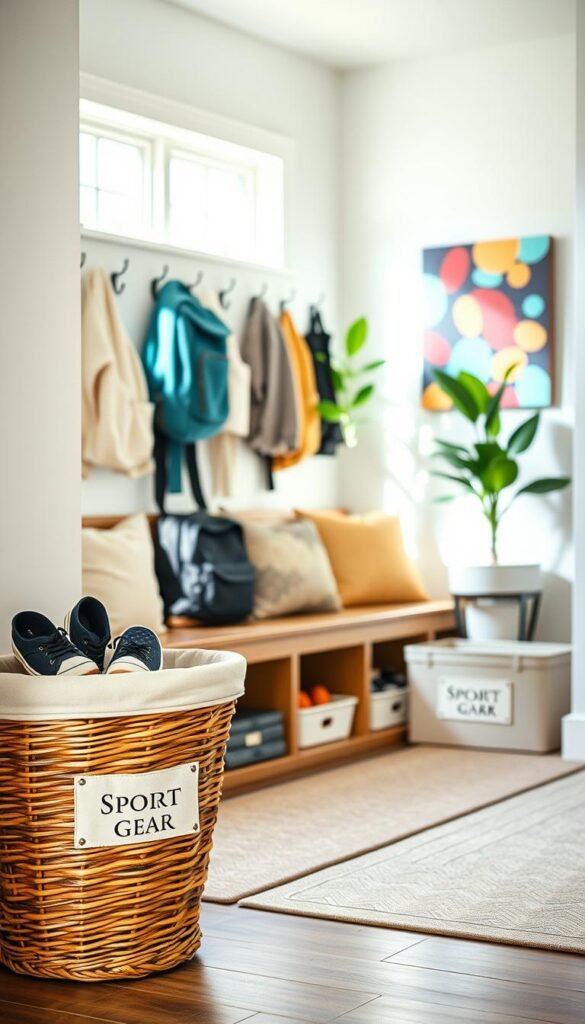
One basket per person
The rule is simple: one container, one owner. That reduces arguments and speeds nightly tidies. Baskets make sorting visible and fast.
Label strategies
Use clip-on tags, card slots, or magnetic letters for flexible labels. These methods let routines change without replacing containers.
Open-top vs. lidded
Open-top baskets support daily access and compliance. Lidded boxes hide overflow and seasonal gear.
„Assigned baskets reduce decision fatigue and make tidy-ups a family habit.“
| Container | Quick use | Pros | Cons |
|---|---|---|---|
| Open-top basket | Daily essentials | Fast access; visible | Shows clutter |
| Lidded box | Seasonal extras | Conceals overflow; stackable | Extra step to open |
| Bucket (magnetic tags) | Seasonal rotation | Easy relabeling; portable | Smaller capacity |
| Matching set | Shelf uniformity | Calmer look; easier sizing | Higher upfront cost |
Buying notes: check shelf dimensions, handle comfort, wipeable materials, and whether identical containers will simplify the visual field. For product ideas and organization tips, see basket and labeling suggestions.
Pet-friendly drop zones for leashes, toys, and water bottles
Paws, leashes, and toys belong in a predictable place so routines stay smooth. Pet gear is high-frequency clutter. A small, planned pet module keeps collars, leashes, and toys off the floor and ready to go.
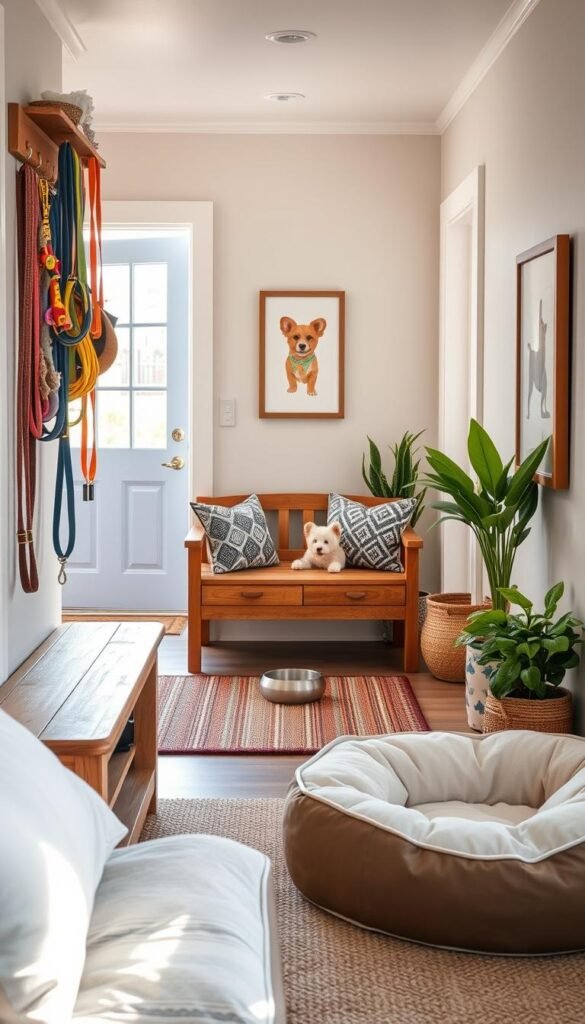
Cubby-and-basket storage that keeps pet gear off the floor
Cubby-and-basket setups work well for dogs and cats. Slide a labeled basket into a lower cubby for toys and another for grooming tools. Keep a separate hook or small bin for leashes so they don’t tangle.
Tip: use wipeable finishes and a washable rug under the cubby to handle muddy paws. Even a single lower cubby can act as a pet module within a larger zone without a full remodel.
Water bottle staging and spill prevention near the door
Store water bottles upright in acrylic containers inside a basket to stop spills. Upright dividers or a small bottle rack inside the basket keeps bottles from tipping during grab-and-go moments.
Choose tile or wipeable surfaces near the door for easy cleanup. For renter-friendly options and small-space ideas, see a quick guide to freestanding solutions and adhesive-friendly setups at renter storage ideas and a practical mudroom reference at mudroom planning.
„A small pet module saves time and keeps the floor clean between walks.“
| Solution | Good for | Pros / Cons |
|---|---|---|
| Lower cubby + basket | Dog households | Pro: fast access; Con: shows contents |
| Hook + small bin | Leashes & collars | Pro: untangles; Con: limited capacity |
| Acrylic bottle holder in basket | Walkers & families | Pro: spill control; Con: extra piece to clean |
Go vertical: shelves, tall bookcases, and door organizers for tight entryways
When floor space is tight, building up instead of out recovers storage without shrinking the path. Vertical approaches keep a narrow room usable while adding clear places for everyday gear.
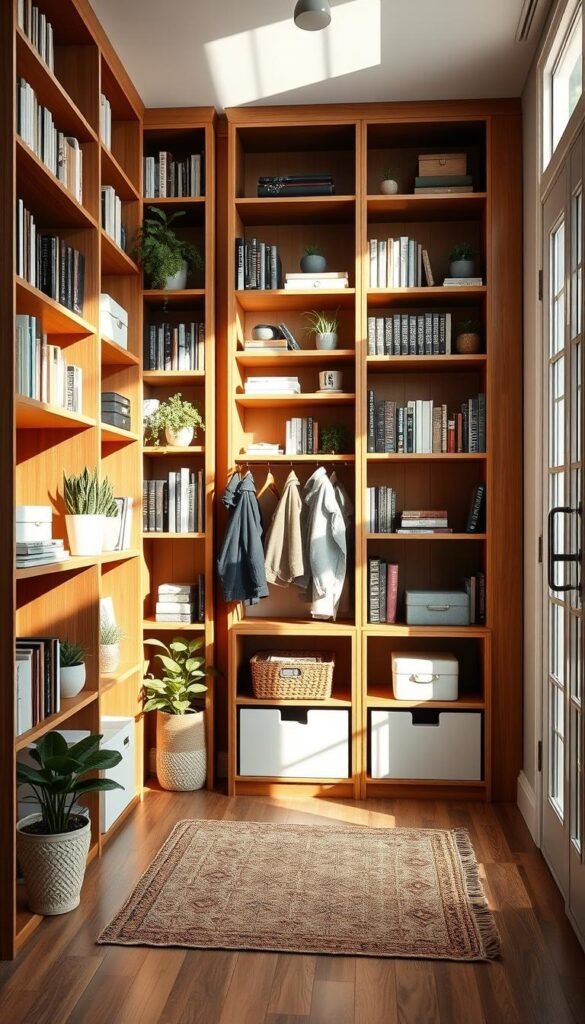
Floor-to-ceiling open shelving to maximize zone space
Floor-to-ceiling shelving uses wall height to store boxes, baskets, and seasonal items. Slim bookcases can fit beside a door, but tall units should be anchored to the wall for safety.
Open shelving gives fast visibility and flexible stacking. Use uniform baskets to reduce visual clutter if many items will be stored.
Shallow drawers and divided organizers for small-item control
Shallow drawers with divided trays tame the usual junk pile. Assign compartments for keys, badges, and chargers so small items don’t migrate across counters.
Choose a shelf depth of 10–12″ for narrow halls and drawer heights of 2–4″ for easy access without bulk.
Back-of-door storage for cleaning supplies and grab-and-go gear
Door-mounted organizers reclaim otherwise unused space. They work well for sprays, leashes, umbrellas, and quick grab items. Confirm door clearance and hinge swing before installation.
Safety notes: keep heavy or hazardous goods off the door racks and place cleaners out of reach of children and pets.
„Vertical storage multiplies capacity while preserving the main walkway.“
| Solution | Typical depth | Mounting / safety | Renters vs homeowners |
|---|---|---|---|
| Floor-to-ceiling open shelves | 10–14″ shelf depth | Anchor top & bottom; stagger heavy items low | Homeowners: built-in look; renters: freestanding anchored unit |
| Shallow drawer units | 10–12″ depth; 2–4″ drawers | Check glide weight; anchor tall stacks | Good for both; choose removable units for renters |
| Back-of-door organizers | 2–6″ pocket depth | Confirm door swing & avoid overloading | Excellent for renters; removable and non-damaging |
| Slim bookcase with baskets | 8–12″ depth | Anchor to wall; heavy items on lower shelves | Versatile: freestanding suits renters; built-in for owners |
For compact mudroom ideas that fit limited footprints, see a practical guide to small solutions at small mudroom solutions. For more small-space shelving and storage options, check this small-space storage resource.
What to compare before you buy entryway drop zone products
A reliable purchase starts with a quick walk-through and a tape measure in hand. Measure depth, walkway clearance, and how the door swings. These simple checks prevent blocked paths and awkward fits.
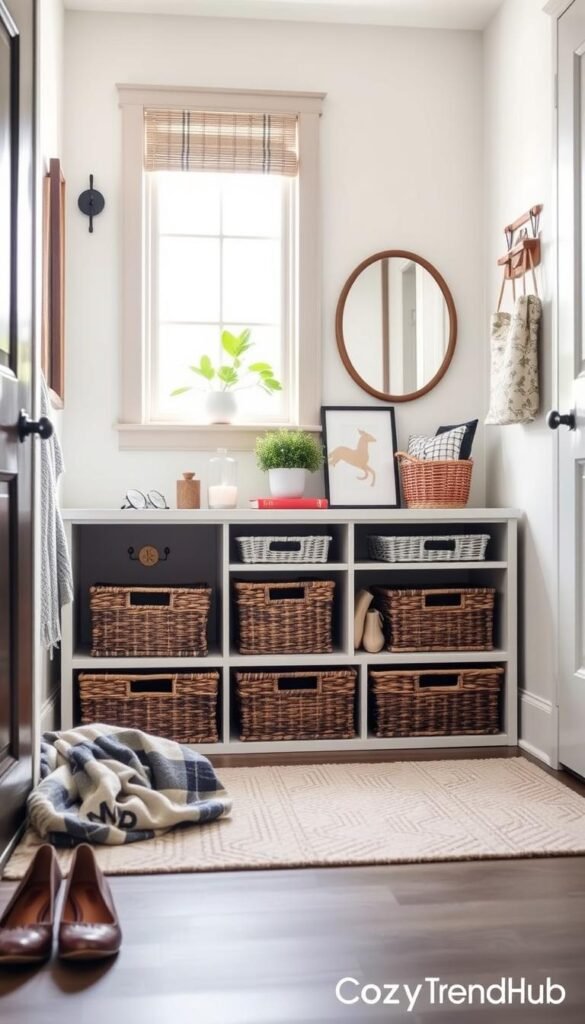
Measure first
Checklist: unit depth vs walkway clearance, door swing, and bench footprint. Allow 30–36″ for a clear way if possible. For slim halls, choose shelves under 12″ depth.
Mounting and safety
Anchor tall bookcases near the wall and confirm hook weight limits for backpacks. Use anchors or toggle bolts for drywall. For renters, prefer over-the-door organizers or adhesive cork tiles to avoid damage.
Open vs. closed storage
Open storage speeds compliance and keeps items visible. Closed units hide clutter but can hide mess and reduce daily follow-through. Match choice to household habits.
Materials and cleanability
Pick wipeable finishes for messy seasons. Tile or a washable rug under shoe trays speeds cleanup. Avoid fabrics that trap salt and mud unless they are machine washable.
Modular vs. built-in looks
Modular pieces can mimic custom installs when aligned and finished with simple trim. This gives a built-in feel without remodeling and suits renters or budget projects.
„Measure, anchor, and choose materials that match how your household actually uses the room.“
| Criteria | What to check | Renter notes |
|---|---|---|
| Dimensions | Depth, height, walkway clearance | Prefer slim units; measure door swing |
| Install type | Freestanding, wall-anchored, door-mounted | Door-mounted or adhesive where drilling is banned |
| Safety | Anchors for tall shelves; hook weight limits | Choose light loads or anchored freestanding units |
| Cleanability | Wipeable finishes, tile, washable rugs | Pick materials that resist salt and mud |
Seasonal resets and simple maintenance to keep your drop zone from becoming a catchall
A brief seasonal reset prevents one shelf from holding a year’s worth of gear. Over time, seasons change but storage often does not. That mismatch is why many systems spill into clutter.
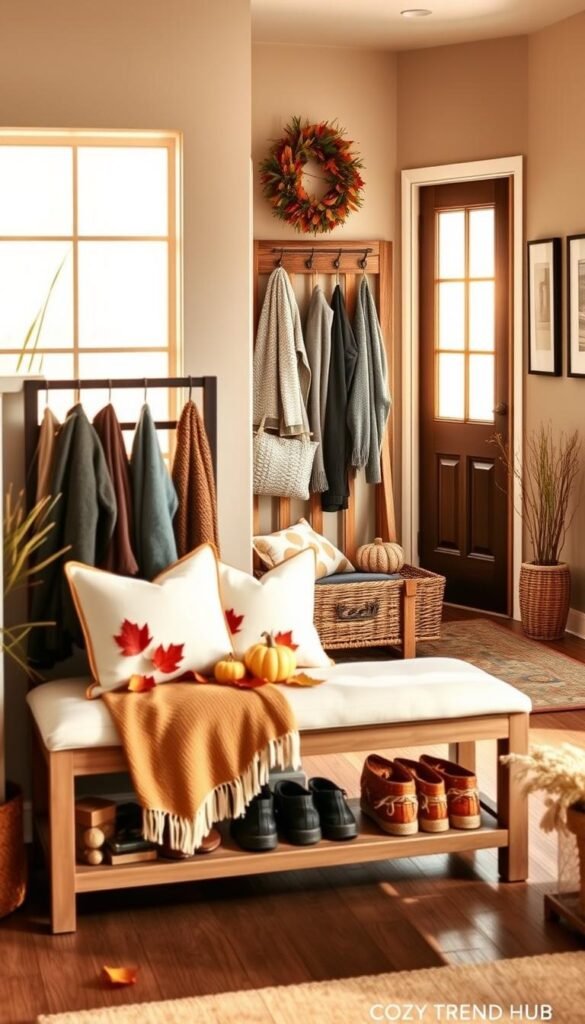
Cold-weather containment
Focus on containment for wet gear. Put boots and wet shoes on a drip tray or boot mat near a garage or mudroom.
Hang heavy coats on sturdy hooks and keep gloves and hats in labeled baskets that are easy to reach.
Warm-weather swap
Shift to a grab-and-go layout. Move sports gear, hats, and sunscreen to a visible shelf or basket by the door.
Stage refillable bottles upright in a basket so a last-minute refill takes seconds.
Weekly five-minute reset
Set a short routine that fits daily life. Each week, clear the landing surface, empty paper slots, and return stray items to assigned spots.
This quick habit prevents overflow and keeps shoes and coats from migrating across the house.
„A maintained zone protects daily life from avoidable stress.“
- Product tie-ins: use lidded bins for off-season storage, open baskets for daily items, and a bench to encourage immediate shoe removal.
- Practical tip: rugs in dirty areas and drip trays under boots cut tracked-in mess.
- Routine benefit: fewer lost items, faster departures, and cleaner floors without perfection.
| Season | Core items | Recommended product |
|---|---|---|
| Cold | Coats, boots, gloves | Drip tray, sturdy hooks, labeled baskets |
| Warm | Hats, sports gear, bottles | Open baskets, shallow tray, bottle holder |
| Weekly | Paper, loose items, shoes | Clear surface; return to labeled spots |
For a step-by-step refresh and product ideas, see entryway organization tips.
Conclusion
A practical finish line is choosing a single, visible landing spot and committing to it for 30 days.
Follow the decision path: list what lands in your hands, choose the least-friction spot in your house, pick storage that matches capacity, then run the buying checks below.
Quick buying checklist: measure clearance, confirm mounting safety, pick open vs. closed storage intentionally, and prioritize wipeable materials for messy seasons.
Renters and small-space homes can use freestanding pieces or adhesive hooks and still create drop zone solutions that work. Start small—one keys tray plus a shoe tray or a labeled basket for bags and mail—and build from there.
Maintenance tip: do a seasonal swap and a five-minute weekly reset to keep the spot useful and avoid it becoming a catchall.