
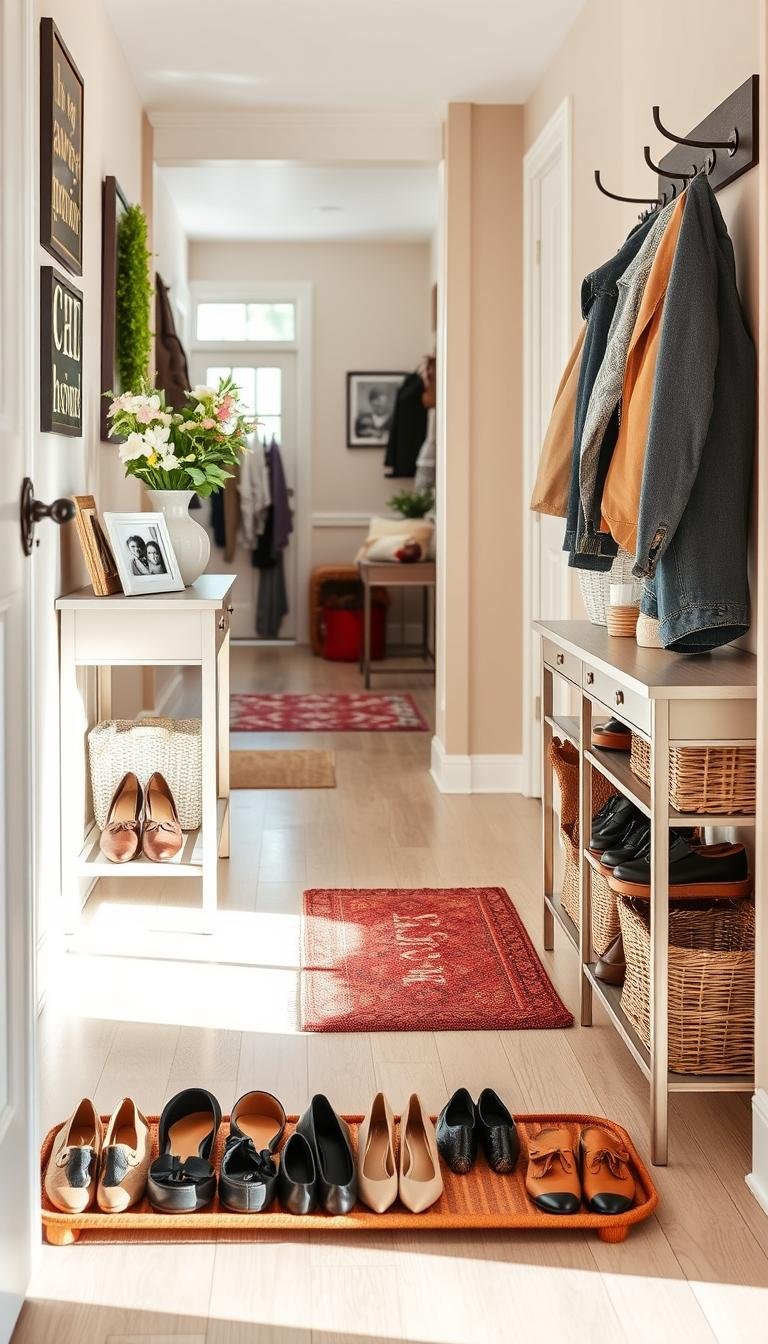
The everyday rush at the door is a common problem in busy homes. Mornings slow down when coats, shoes, and keys scatter. This guide frames a simple fix: diagnose the clutter, assign three core jobs, and pick solutions that fit real life.
Three core jobs matter more than looks: reliable outerwear storage, a grab-and-go drop zone, and a place to sit for shoes. Each job shapes what to buy and where to place it. The focus is on renter-friendly, small-space options that do not demand major installs.
Readers will get practical buying cues: weight limits, install needs, and pros and cons for wall hooks, closets, benches, and compact shelving. The promise is modest and useful — functional storage that survives daily traffic, not a showroom setup that needs constant upkeep.
Key Takeaways
- Clear goals—coat storage, drop zone, seating—make fast mornings possible.
- Solutions prioritize small spaces and renter-friendly installs.
- Product picks include pros/cons, weight limits, and install notes.
- Focus on cutting clutter without losing valuable floor space.
- Choices are presented by use case to support confident buying decisions.
Why entryways get messy in busy homes and what a functional setup fixes
Morning exits stall when daily essentials pile up at the threshold. That single cluttered area becomes a friction point on a work or school day.
High-traffic drop zone failure
Everything lands in one pile: keys, backpacks, mail, and paperwork vanish when the family needs them most. This costs minutes and raises stress before the day starts.
Small-space bottlenecks
Narrow halls, tight door swings, and limited floor area force shoes and coats into the walking path. The pile grows until passing through the door is awkward and slow.
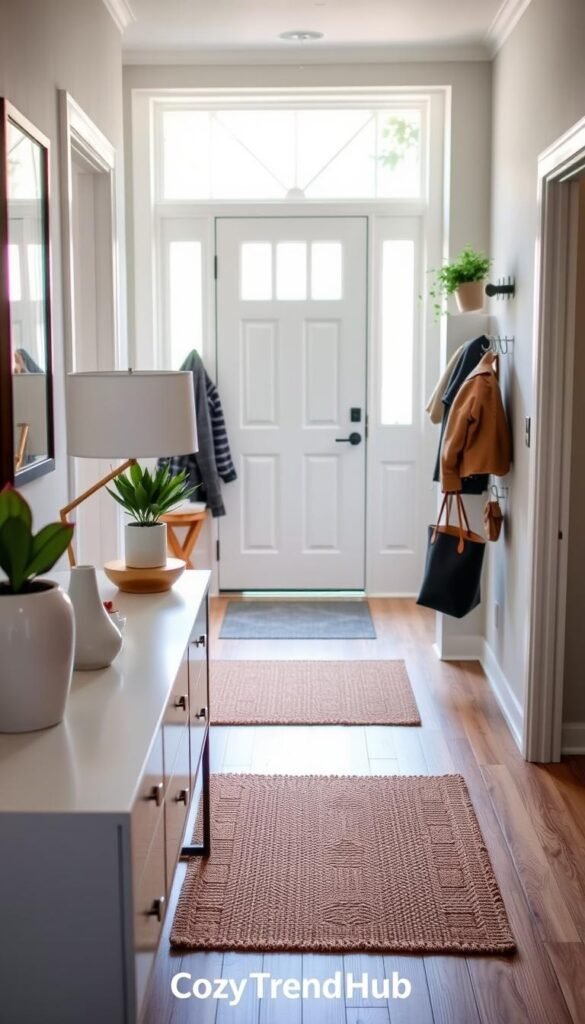
Core solution principle
Assign a defined spot for outerwear, shoes, mail/keys, and bags. Even a small wall area can become a one-stop spot for the in-and-out flow.
| Common Problem | Practical Fix | Why it works |
|---|---|---|
| Piled mail and keys | Shallow ledge + bowl | Keeps small things visible and reachable |
| Shoes blocking path | Stacked rack or slim bench | Contains footwear without widening the area |
| Coats on chairs | Strong wall hooks at person height | Prevents overflow and keeps coats accessible |
Choosing the right unit matters. Wrong depth, weak hooks, or oversized catch-alls can create new clutter instead of fixing it. A simple, reliable system that fulfills a few key jobs saves real time and keeps the door area ready for the next day.
The three jobs every entryway must do to stay organized
A thoughtful threshold does three simple jobs that stop clutter before it spreads.
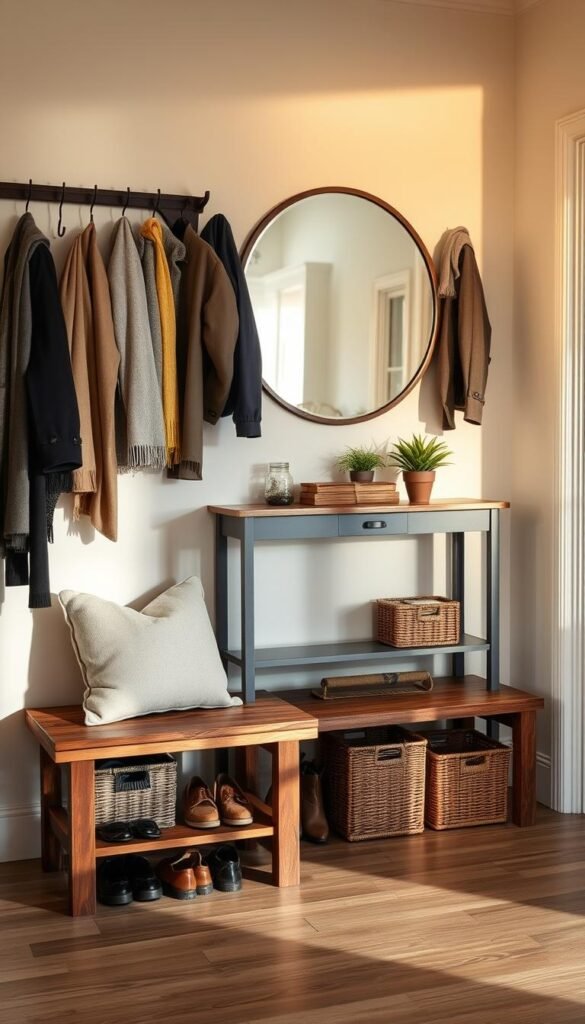
Outerwear storage for coats, jackets, and shoes
Define the job: Hold daily outerwear so items leave the path clear. This includes sturdy hooks for coats and rails for jackets. Add a slim shoe rack or cabinet for quick shoe handling.
A grab-and-go spot for keys, mail, sunglasses, and daily items
Why it matters: A dedicated ledge, tray, or shallow shelf keeps keys and mail visible. When small items have one place, counters stop becoming the dump spot.
A place to sit to put on and take off footwear
Practical result: A compact bench or stool makes shoe changes easier and reduces floor piles. Choose a bench with cubbies or a slim drawer if space allows.
Decision rule: If a product does not improve at least one of these jobs, skip it for small spaces. Systems that make the right action easiest win with busy families.
Plan your layout based on lifestyle, climate, and how you actually live
Designing a door-zone around how your household actually moves makes daily comings and goings smoother.
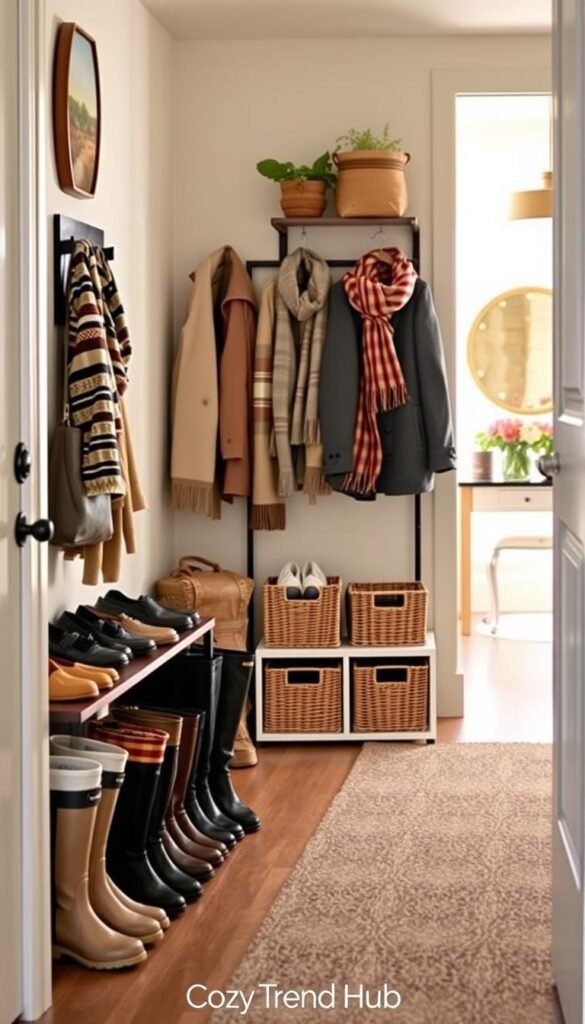
Rainy-day and winter gear
Assign a defined spot for umbrellas, wet boots, and drip-prone stuff. A waterproof tray or slatted mat protects floors.
Choose materials that clean easily — metal racks or plastic-lined bins work for heavy, wet gear. Match weight capacity to boots and snow gear.
Sports, music lessons, and commuting
Plan one gear nook for bags, instruments, and coats. A tall cubby or wall hooks plus a slim bench keeps gear from migrating into the room.
For heavy cases, pick anchors or freestanding holders that tolerate the load. Of course, durability matters more than extra shelves.
Be realistic about upkeep
Decide if the household will do a two-minute daily reset or needs a grab-and-go system that hides clutter.
Quick planning method: watch what gets dropped first, note what is searched for most, and mark traffic jams near the door.
| Situation | Recommended option | Why it works |
|---|---|---|
| Frequent rain | Waterproof tray + umbrella stand | Protects floors and contains drips |
| Weekly sports/music | Dedicated cubby or tall hook set | Prevents overflow into living areas |
| Minimal household | Shallow ledge + bowl | Simple, low-profile spot for keys and mail |
Keep planning tied to purchases. Heavy, wet gear calls for high-capacity hooks and easy-clean finishes. Light daily items do fine with slim ledges and small containers.
For more practical ideas, see practical ideas that match common family routines and budgets.
Best entryway organization starts with using your wall space
Walls offer the quickest upgrade for tight thresholds that need to move people, not things.
Why use vertical space: Mounting storage frees the floor and keeps pathways clear. In small homes, a slim unit changes traffic flow without bulky furniture.
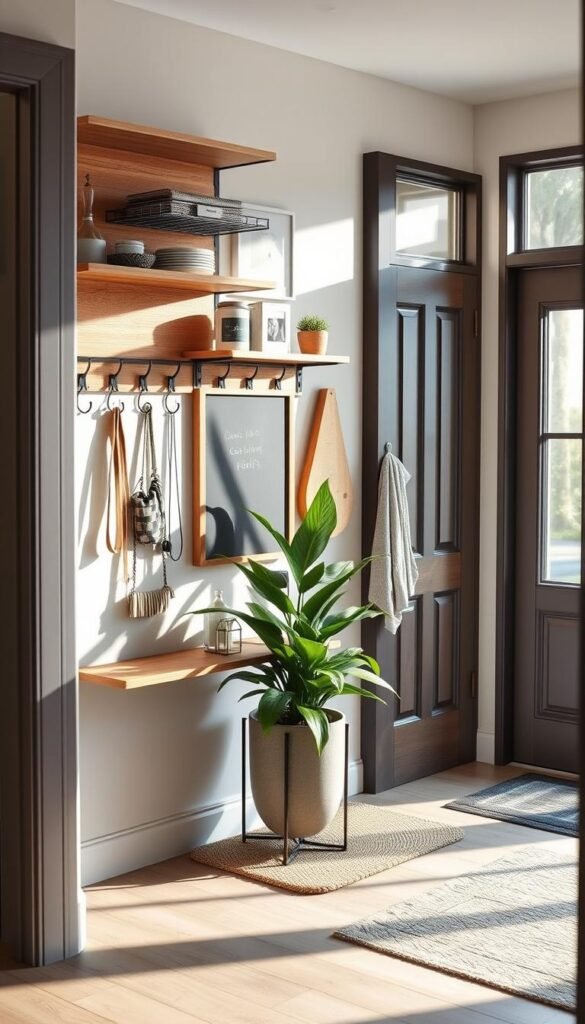
Wall-mounted organizers that combine hooks plus a slim ledge
A hooks-and-ledge setup handles two tasks at once: coats and bags hang while keys and mail sit on a narrow surface that resists piles.
Scout Regalia SR Wall Rack is a clear example. It is 17.5″ wide with a 2.5″ ledge and holds up to 50 lb on drywall. Mounting into a stud raises that safety margin for heavy loads.
Above-door storage: floating shelf with baskets
A floating shelf above the door becomes a „rarely used“ zone for seasonal items. Use baskets to keep small accessories contained and out of daily sight.
When to anchor into studs vs drywall
Heavy coats and full bags should go on studs when possible. Drywall anchors work for lighter loads, but check rated capacity before trusting heavy use.
| Feature | Why it matters | Buyer check |
|---|---|---|
| Depth (ledges/shelves) | Too deep blocks door swings; shallow keeps the hall open | Prefer ≤3″ for narrow halls |
| Hook style | Snag-free pegs prevent torn straps; curved hooks hold coats securely | Look for rounded ends and weight rating |
| Mounting needs | Stud vs anchor determines real capacity | Choose stud-mount for heavy bags and coats |
For renters or tight layouts, see practical alternatives and renter-friendly ideas at home storage ideas for renters.
Renter-friendly entryway organization options for apartments and no-foyer homes
A small, well-placed setup can turn a cramped hall into a practical drop spot. This section lists low-impact options that work without drilling or major installs.
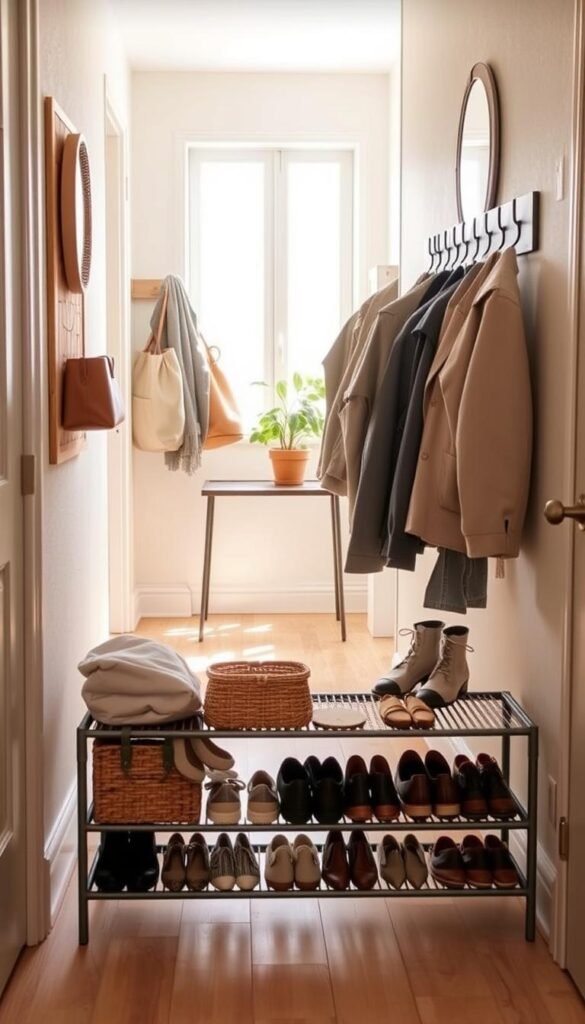
Magnetic key racks for metal doors and fridges
Why choose magnetic: When drilling isn’t allowed, magnets hold keys and mail at eye level. That keeps counters clear and items easy to find.
Example: The Yamazaki Rin Magnetic Key Holder mounts by magnet or screws. It is 7″ wide, has five hooks, holds up to 4 lb, and offers room for a few letters or a slim wallet.
Ultra-slim wall organizers for tight halls
Low-profile ledges and shallow hooks free up floor space and prevent snagging on door swings. Aim for just over 4 inches depth or less for narrow corridors.
Example: Ilan The Control Panel sits about 4″ deep. Its magnetic hooks hold very light items (~0.5 lb) while a fixed hook can carry heavier pieces when anchored.
| Feature | Yamazaki Rin | Ilan Control Panel |
|---|---|---|
| Mount type | Magnet or screw | Magnet + configurable fixed hook |
| Depth / Width | 7″ wide, shallow profile | ~4″ deep, very low profile |
| Capacity | Up to 4 lb total | Magnetic hooks ~0.5 lb; fixed hook heavier |
Buyer guardrails: Confirm the surface is metal for magnets. Check weight limits and avoid overloading magnetic hooks with heavy keychains or bags. Remember: a small wall area is enough to create a reliable one-stop spot—no mudroom required.
Optimize entryway closet storage with vertical space (no renovation required)
Vertical thinking turns a shallow closet into a high-capacity hub.
Start with a quick reset: clear the floor, sort items by category, and rebuild from bottom to top. This simple sequence reveals how much vertical space is unused.

Tiered shoe racks that increase capacity
Why they matter: Tiered racks stack pairs upward, so more shoes fit without widening the floor footprint. Pick stackable metal or plastic units that match the closet depth.
Buy tip: Choose racks with non-slip feet and a top shelf deep enough for rolled umbrellas or small bins.
Baskets on shelves to corral small items
Use sturdy baskets on higher shelves to contain gloves, scarves, and other loose items. Label each basket for quick grabs.
Measure shelf depth before buying. A snug basket prevents tilt and keeps the shelf neat.
Matching hangers to reduce visual clutter
Swap mismatched hangers for a uniform set to make coats easier to scan. Slim, durable hangers save space and keep coats aligned.
Practical rule: reserve heavy-duty hangers for winter outerwear and slim ones for lighter jackets.
What to remove so the closet stays functional
Set a strict boundary: remove gift wrap, extra household storage, and unrelated boxes. An entry closet with fewer categories stays tidy longer.
„A closet that holds just daily gear reduces mystery piles and speeds morning routines.“
- Clear floor and sort by category.
- Add tiered shoe racks at the base.
- Place baskets on upper shelves for small items.
- Standardize hangers for coats and jackets.
| Item | Suggested product | Why it helps | Buyer note |
|---|---|---|---|
| Tiered shoe rack | Stackable metal shelves | Increases shoe capacity without more floor space | Match rack depth to closet floor depth |
| Shelf baskets | Woven or plastic bins sized to shelf | Contains gloves, scarves, small items | Label and use uniform sizes for stacking |
| Matching hangers | Slim non-slip hangers | Reduces visual clutter and keeps coats aligned | Use heavy-duty options for bulky winter coats |
For compact solutions and product ideas, see closet organizers for small closets.
Shoe storage that actually works for small spaces and busy schedules
A clear plan for where shoes live saves time and prevents piles from forming after school or work. Pick a solution by measuring available width and depth, then match that to how often people pass through the door each day.
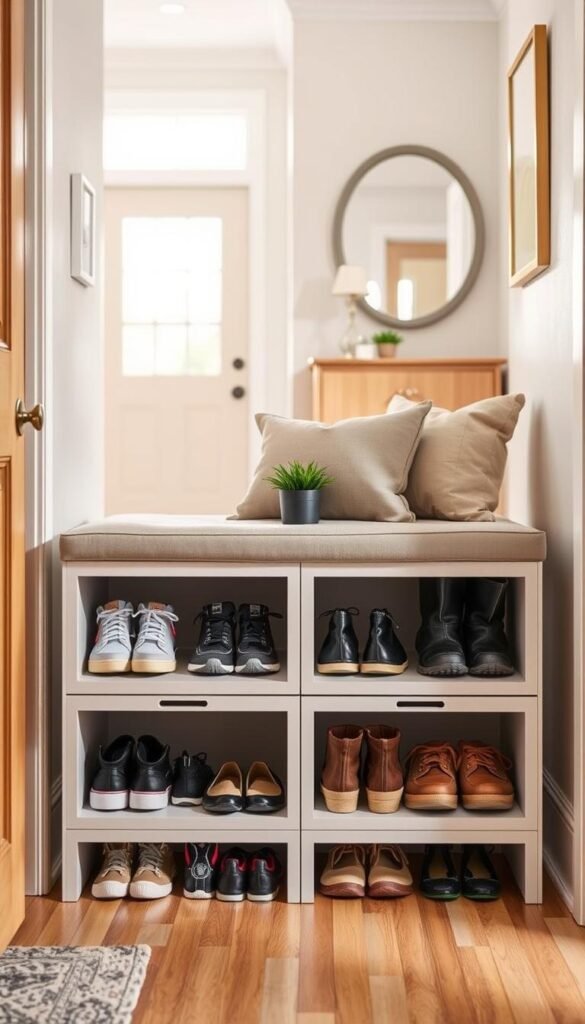
Open racks vs closed cabinets: trade-offs for speed, smell, and look
Open racks give fastest access and better airflow. They help wet pairs dry quicker and suit families that run in and out several times a day.
Closed cabinets hide visual clutter and create a calmer look. They can trap odors, so add vents or rotate shoes regularly.
Boots and wet-shoe handling for seasonal weather
Give boots a drying-friendly zone: a waterproof tray, slatted mat, or dedicated shelf that keeps water off rugs. Move wet pairs out of the main cabinet until dry.
Capacity planning: how many pairs per person should live near the door
Rule of thumb: store 2–4 daily pairs per person—one daily shoe, one casual, one work/sport, plus one spare. Follow a daily pairs only approach and rotate others to underbed bins or a secondary closet.
| Measure | Decision | Why it matters |
|---|---|---|
| Width/Depth | Choose rack or cabinet size | Prevents overflow into walkways |
| Traffic per day | Open = high traffic; closed = low traffic | Matches access speed to household pace |
| Wet-weather | Drying zone + ventilated storage | Protects floors and reduces odor |
For a deeper product comparison of racks and cabinets, see this shoe rack vs cabinet guide.
Coat storage solutions: hooks, pegs, rails, and coat racks compared
Choose the right hanging method to match your wall space, household habits, and traffic flow.
Vertical hook racks make the most of narrow walls and tight corners. They stack hanging points upward so several jackets fit in less width. For small halls, this reduces blocked walkways while keeping outerwear visible and easy to grab.
Swivel hooks work well where multiple people share one zone. Each swivel becomes a clear spot for a single person’s items. That reduces mix-ups and keeps scarves, bags, and a coat grouped together instead of spread across several hooks.
Freestanding coat racks help when drilling isn’t an option or when a wall surface is absent. They are useful near a bench or in open foyers. But test them before committing: racks can become a visual catchall if household members drop bags or random items there.
Buying considerations
- Weight capacity — match hooks or rack specs to heavy winter coats and bags.
- Hook spacing — allow room so bulky coats do not overlap and create tangles.
- Mount type — stud-mounted hooks increase real capacity over drywall anchors.
- Personal zones — swivel hooks or labeled pegs help households divide spots by person.
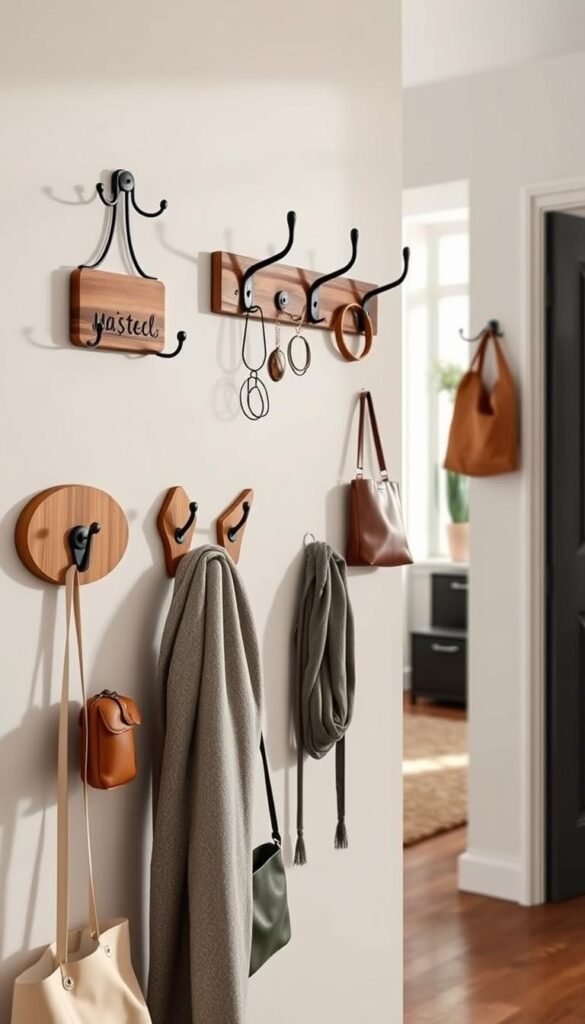
| Solution | Best for | When it backfires |
|---|---|---|
| Vertical hook rack | Tight walls and corners; saves floor space | When hooks are too close and coats compress into a lump |
| Swivel hooks | Shared family zones where each person needs a dedicated spot | If not enough hooks are installed, people still spill into other areas |
| Rail with pegs | Hallways that need a mix of hanging and a slim ledge | Deep rails can protrude into traffic paths |
| Freestanding coat rack | No-drill scenarios or open-plan spaces with room for floor units | Becomes clutter if it lacks defined capacity or is placed in a busy path |
Quick test: imagine the morning rush. If everyone reliably hangs a coat, open hooks work. If coats pile or personal items mix, choose swivel hooks or a system that forces one spot per person. For a compact consolidated solution, consider a freestanding cabinet that adds shoe storage and a bench — but only if it replaces missing categories and does not add clutter.
For more style-forward options and examples of rail-and-hook combos, see design-forward hooks, rails, and racks.
Build a grab-and-go drop zone for keys, wallets, mail, and chargers
A focused spot for daily items keeps small clutter from taking over every flat surface.
Start with a decision tree: if floor space allows, add a console or side table with drawers. If not, pick a wall-mounted command center that frees counters and holds essentials.
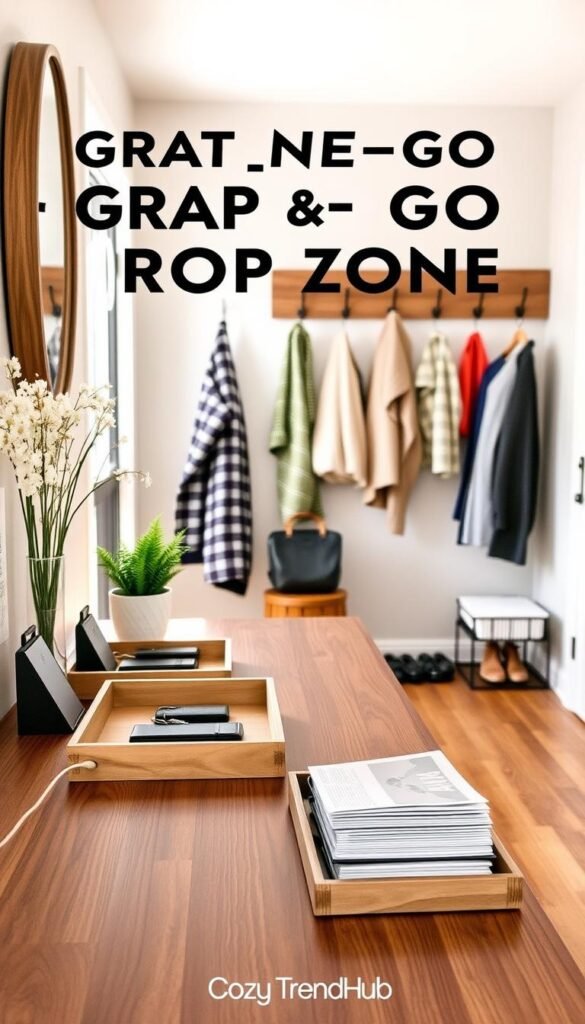
Console and side tables with drawers for high-traffic homes
Drawers hide visual mess while keeping items reachable during busy mornings. Use drawer dividers to separate keys, wallets, and chargers so nothing vanishes under paper.
Trays, bowls, and lidded jars when there is zero surface space
Choose containers sized to the contents. A small bowl for keys, a slim tray for mail, and a lidded jar for chargers stops catch-alls from becoming catch-everything.
Wall command-center alternatives
Mount a slim ledge with hooks and a tiny mail sorter. This keeps counters clear and gives a permanent place for daily items without widening the path.
Container rules: one container per category (keys, wallets, chargers). Make each container only as big as the items it must hold to prevent overfilling.
| Problem | Solution | What to shop for |
|---|---|---|
| Cluttered counters | Console/side table with drawers | Small table with 1–2 drawers, drawer dividers |
| No floor space | Wall command center | Slim ledge, hooks, mail sorter |
| Zero surfaces | Targeted catch-alls | Shallow tray, key bowl, lidded jar sized to items |
For compact product ideas and layouts, consult a useful roundup from Wirecutter on small-space solutions: small-space drop zone ideas.
Entryway seating that doubles as storage (benches, stools, and chairs)
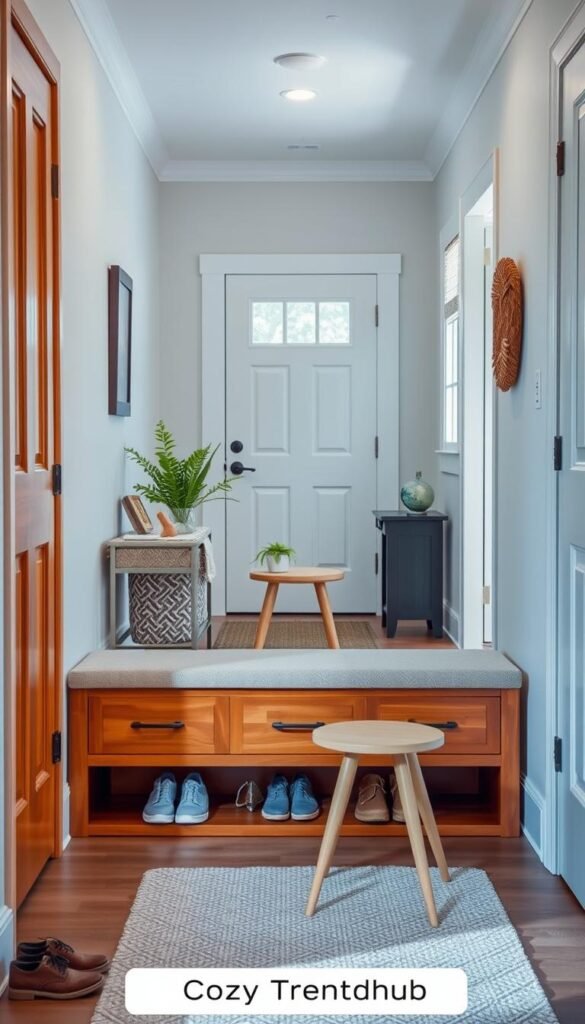
Why seating matters: A seat is not decorative in a busy home. It speeds shoe changes and reduces the habit of dropping shoes into walkways.
Benches with drawers for kid-friendly access and quick shoe changes
Choose a low bench with shallow drawers so children can reach shoes and small items. Benches anchor the routine: sit, stash, and go.
Use the drawers for socks, laces, or a small shoe brush. That keeps the top clear and enforces a single spot for daily pairs.
When a small stool is better than a bench in tight areas
In narrow halls a compact stool tucks easily under a shelf or beside a lean rack. It creates a seat without blocking door swing or traffic.
Buyer checks: pick wipeable surfaces for wet seasons, confirm weight capacity, and decide if seating is used daily or only sometimes.
- Measure door swing and maintain a clear 30–36″ path for walkways.
- Pair seating with nearby shoe storage so footwear stays in one room.
Create a family-friendly system with zones so clutter stays contained
Give each person a clear zone so things stop spreading across the hall.
Zoning is the simplest way to keep clutter contained. When each family member has one defined place, coats, bags, and small daily items stop wandering and getting lost.
Assign a cubby, shelf, or hook set per person to prevent mix-ups
Set one hook set for coats and bags and one small shelf or cubby for daily things like wallets, lunch notes, and school papers. One place per person reduces confusion and speeds morning exits.
Install hooks at kid height so backpacks and coats get hung up every day
Mount at a reachable height for the youngest child. When hooks are easy to use, kids hang items without nagging. Durable metal hooks with 4–6″ spacing work well for heavier backpacks and winter coats.
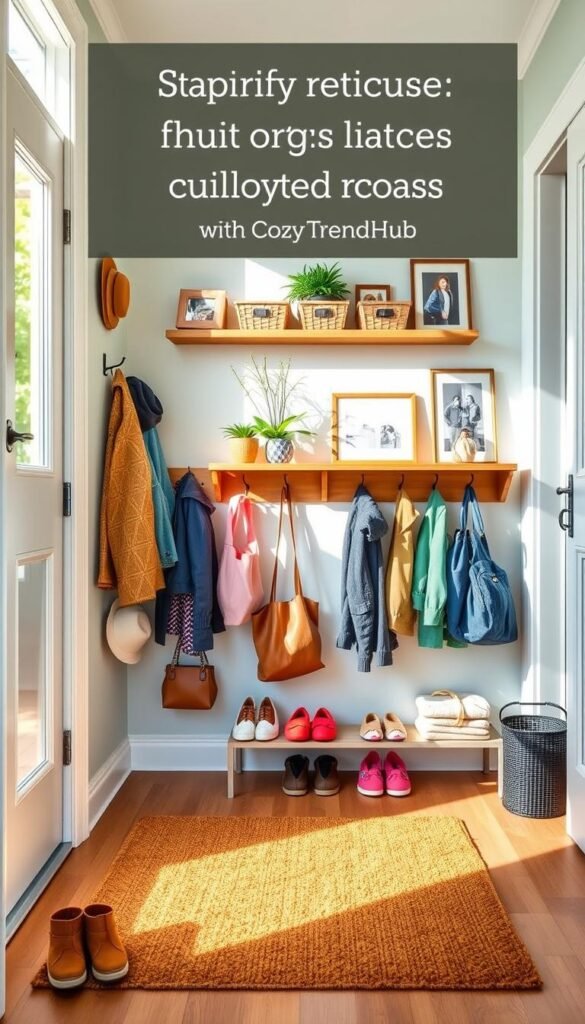
Limits by design: size each zone to daily needs so overflow signals a reset. If a cubby holds only two items, extra gear must be rotated to another storage place.
| Zone | Recommended fixture | Why it works |
|---|---|---|
| Child zone | Low hooks + small shelf/cubby | Makes hanging natural and stores daily things within reach |
| Adult zone | Sturdy hooks + narrow shelf | Handles heavier bags and a spot for keys or wallets |
| Sports/music | Dedicated hook + labeled bin | Prevents equipment from mixing with daily coats and bags |
| Overflow signal | Smaller cubby or single shelf | Encourages rotation when items exceed the zone |
Prevent mix-ups with consistent placement and simple labels. Consider one hook for school bags and one for sports bags. That visual cue reduces morning scramble and keeps the place orderly.
For shelf and cubby options that fit small spaces, see a quick guide to closet ideas at closet organization ideas.
Product picks and comparison-ready recommendations for wall organizers and racks
A compact rack can hold heavy coats while staying slim against the wall. Below are clear, comparison-ready notes to match a practical organizer to a given space and daily routine.
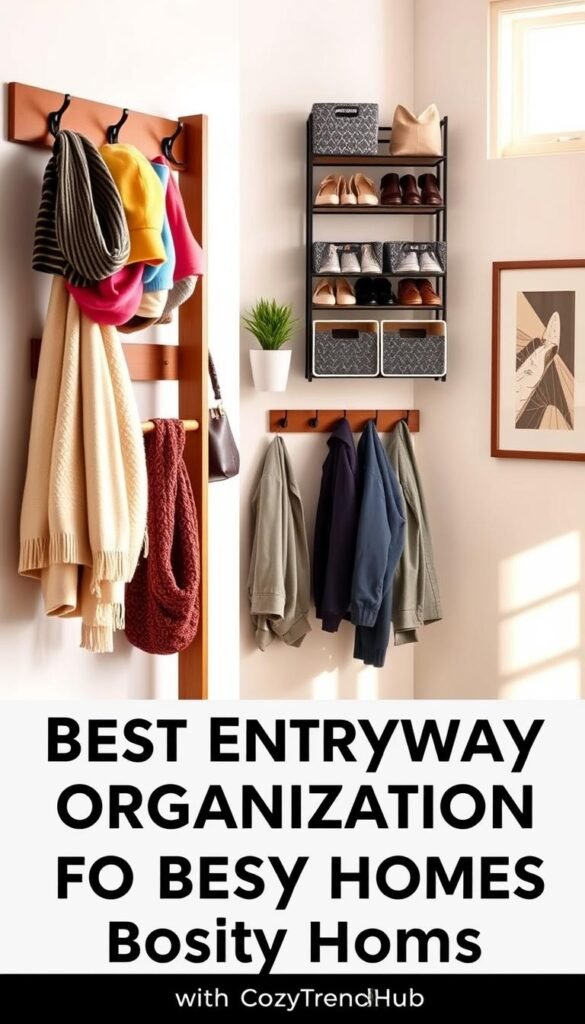
Scout Regalia SR Wall Rack
Who it suits: small halls that need a slim ledge plus sturdy hooks.
Specs: 17.5″ wide, 2.5″ deep ledge, holds up to 50 lb on drywall. Stud mounting recommended for heavier coats and bags.
Pros: dual ledge-and-hook design, solid weight rating. Cons: needs correct anchors for full capacity.
Schoolhouse Mollie 6 Hook
Who it suits: narrow walls that must carry heavy loads.
Specs: under 8″ wide, up to 110 lb capacity, hardware for wood/drywall included. Use studs for max safety.
Pros: high load capacity in minimal width. Cons: simple look may need pairing with a shelf for mail and keys.
Ilan The Control Panel
Who it suits: very tight spaces that need configurable hooks and a low-profile ledge.
Specs: just over 4″ deep; magnetic hooks ~0.5 lb; fixed hook tested with a 10-lb tote. Includes anchors and a drilling template.
Pros: modular layout, renter-friendly pieces. Cons: magnetic parts carry very light loads only.
Umbra Estique Organizer
Who it suits: households wanting a small basket plus key hooks near the door.
Specs: basket ~12″ wide, 3.5″ deep; five hooks rated up to 5 lb each.
Pros: quick catch-all for mail and small items. Cons: not meant for bulky coats.
Most Modest Walter Wall Shelf
Who it suits: people who prioritize a clean mail-and-keys zone with flexible sizing.
Specs: 5″ projection; lengths 11″, 22″, 36″; real-world 10-lb tote held on drywall. Magnetic-friendly steel and integrated cleat mount.
Pros: neat styling and stable shelf depth. Cons: wider lengths need wall space planning.
Yamazaki Rin Magnetic Key Holder
Who it suits: renters or no-drill setups on metal doors or fridges.
Specs: 7″ wide, magnetic back or screw-mount, 4-lb capacity, five hooks plus slot for letters.
Pros: true no-drill option; holds mail and keys. Cons: limited for heavy bags.
Buying considerations
| Feature | Why it matters | Shop for |
|---|---|---|
| Depth | Door swing clearance and walkway space | ≤3″ for narrow halls; 4–5″ for ledge use |
| Weight capacity | Supports coats, bags, or light items | Match rating to winter gear or daily totes |
| Hook style | Prevents snags and holds shapes | Ball-end for coats; magnetic for light keys |
| Install needs | Determines real capacity and renter suitability | Stud mount for heavy loads; magnetic for renters |
Quick pros/cons checklist
- Fast grab-and-go: Scout Regalia or Ilan for ledge + hooks.
- Heavy winter gear: Schoolhouse Mollie or stud-mounted racks.
- Hide visual clutter: Walter shelf or baskets paired with hooks.
- No-drill / renter option: Yamazaki Rin magnetic key holder.
Compare options side-by-side and pick the model that matches door clearance, load needs, and install limits. For additional product ideas and practical setups, see a curated guide on wall organizer picks.
Conclusion
A compact, habit-friendly setup makes leaving the house faster and keeps clutter from returning.
Core takeaway: a system that handles coats, a grab-and-go spot for mail and keys, and a seat for shoes wins over extra furniture.
Start wall-first in tight spaces: one sturdy rack or shelf plus a couple of hooks and a slim tray often outperforms a bulky console. Renters can favor magnetic or no-drill options and shallow shelves to save clearance at the door.
Keep a closet boundary: store daily items in baskets on shelves and rotate seasonal gear elsewhere. Measure depth, check weight ratings, and size containers so they never overfill.
One weekend plan: declutter, assign zones by person, install a rack/hooks, and set a two-minute daily reset. For styling and practical how-to, see the entryway essentials guide.

One Comment