
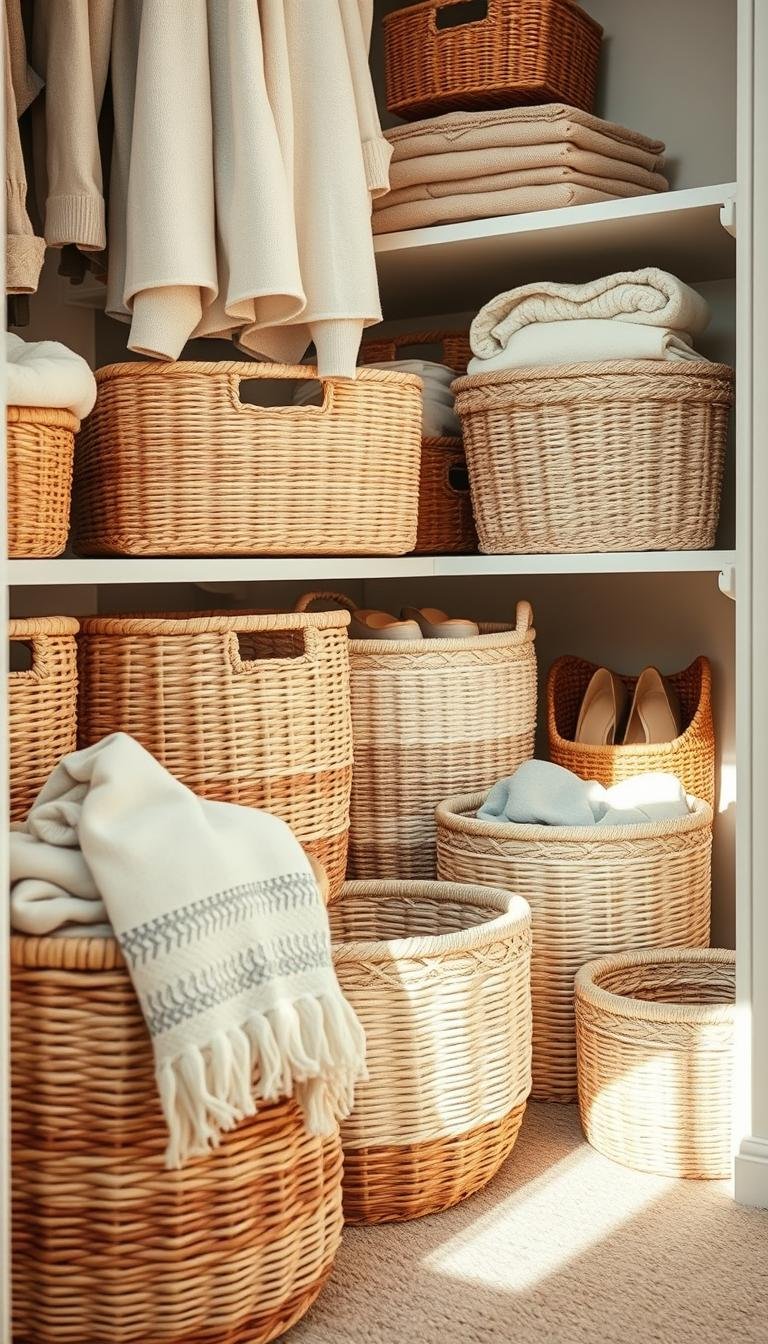
Small spaces fail when things have no consistent home. Items get shoved, visual clutter returns, and tidying feels temporary. This intro shows a practical path for renters and anyone in compact layouts to build repeatable storage zones.
Measure first, buy smart. Choosing the right size prevents wasted price and returns. Opaque bins cut visual noise, but labeling matters because people forget contents over time.
This guide lists five picks for closet baskets and five drawer inserts tied to clear uses: linens, folded clothes, accessories, seasonal storage, and daily essentials. Each recommendation is chosen for durability, size range, visibility, and renter-friendly setup.
Expect honest notes on what each product does well and where it falls short. The page is organized for fast shopping: a short buying guide, best picks, setup tips, and under-bed add-ons. Every product block will include best for, ideal placement, sizing notes, and pros/cons to speed decisions.
For related small-bathroom organization ideas, see a complementary guide at best bathroom organizers for small bathrooms.
Key Takeaways
- Clutter returns without a repeatable system; create simple zones to stop it.
- Measure before buying to match size and avoid extra price or returns.
- Opaque bins reduce visual clutter; always label to remember contents.
- Products chosen for durability, renter-friendliness, and clear sizing.
- No single product fixes clutter; the right container plus good sizing and labeling does.
Why closet clutter keeps coming back in rentals and small spaces
Renters and small-space dwellers often see tidy shelves slip back into disorder within weeks. Limited layouts, shallow shelf depth, and one high shelf that becomes a dump spot create a cycle of mess.
The hidden problem: unstable stacks and junk zones
Vertical piles of clothes topple when shelves are too shallow. Small accessories migrate into gaps. Random things land wherever there’s room, and a single spill creates cascading disorder.
The fix: repeatable zones, not just prettier shelves
Wire storage basket designs stop folded piles from sliding and make pull-and-replace easy. Assigning a basket by category—tops, bottoms, shoes, scarves, accessories—gives each item a default landing spot.
Drawer inserts act as micro-zones that keep small items visible and separated. Labels make contents obvious at a glance and speed cleanup.
- When cleanup has fewer steps, it happens more often.
- Containers move with a tenant and need no drilling.
- A repeatable zone system supports quick resets for shared spaces.
How we evaluated closet baskets and drawer inserts for real-life use
Real homes test storage: bins get tugged, shoved, and overloaded every day. This evaluation focused on what survives repeated handling and still makes daily routines faster.
Durability vs. weight for everyday pull-and-shove storage
Real-life use means containers face drops and overfilling. Metal mesh and a Muji-style wire basket resist deforming but add weight. Plastic boxes are light and easy to clean.
Buyer-intent check: pick a material that balances strength and liftability for your shelf heights.
Visibility and opacity: reducing visual clutter without losing track
Clear storage bins speed searches. Opaque options hide mess but need labels. Labels or writable surfaces reduce mystery bins and wasted pulls.
Size range and modularity for tight shelves and changing needs
Measure shelf width and depth before buying. Modular systems scale after a move and help maintain uniform zones.
Renter-friendly features
Look for no-drill solutions, comfortable handles, and lids that snap on for dust protection. Perforated plastic or SmartStore Nordic styles offer airflow with optional lid use.
„Good bins must be durable enough for drops and shoves but light enough to move.“
| Criteria | What to measure | Why it matters |
|---|---|---|
| Durability vs weight | Lift weight with contents | Ensures ease of use and long life |
| Visibility | Front-to-back shelf depth | Clear bins save time; opaque needs labeling |
| Modularity | Width, height, stack height | Scales for future moves and tight shelves |
| Renter features | Handle grip and lid fit | No-drill, easy carry, dust protection |
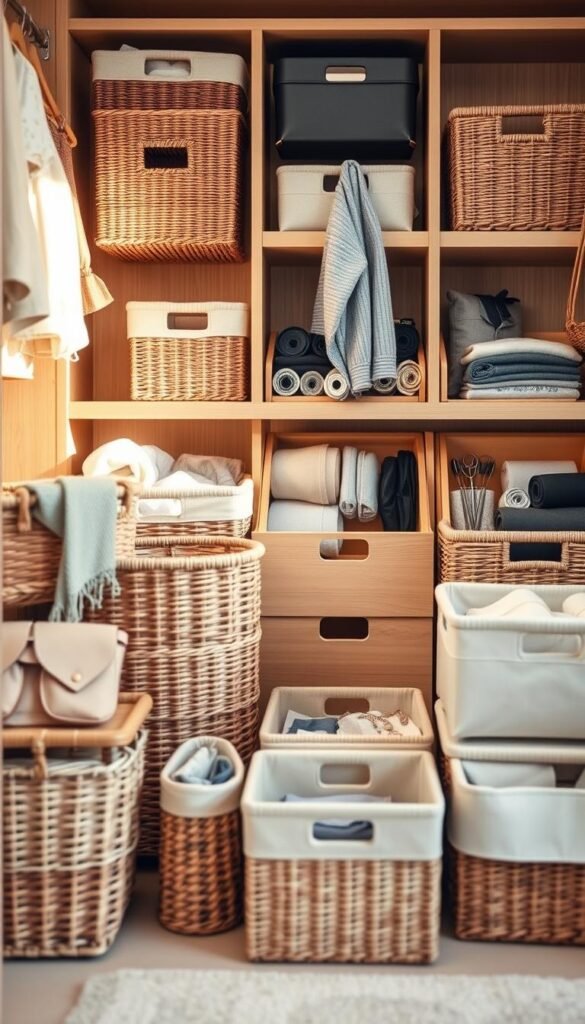
Use the short review format below when choosing: Best for, Where it works, What to measure, Pros, Cons, and Buy if / Skip if. For more renter-focused options, see home storage ideas for renters.
Measure first: the fastest way to avoid buying the wrong storage
Start by measuring the home each container will actually sit in—this single step cuts most returns.
What to measure before you buy: interior width, depth, and height of every shelf and drawer, plus door clearance so items pull out smoothly.
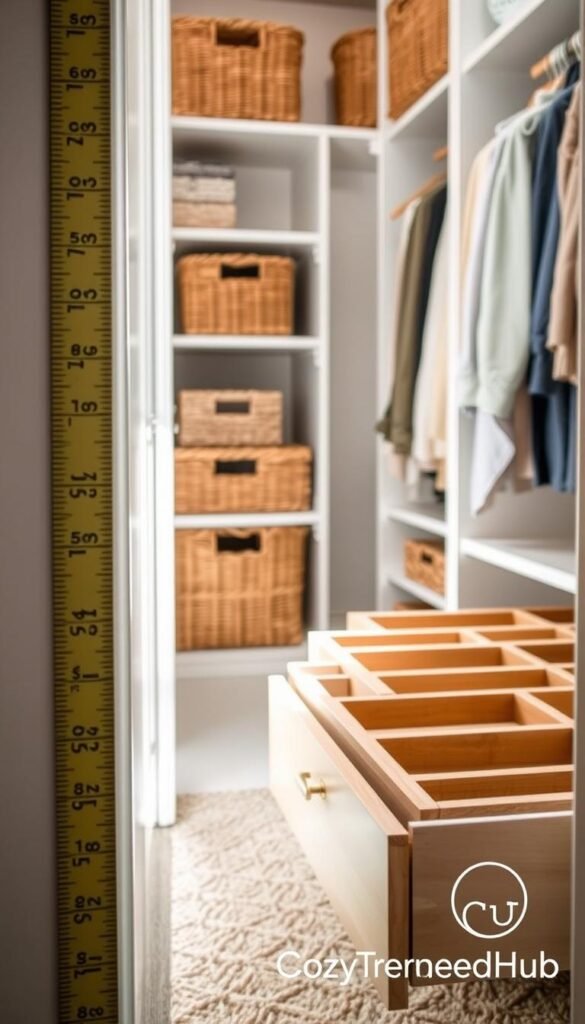
Closets, shelves, and drawers
Usable depth matters: leave a couple inches behind handles so boxes slide without scraping. For shelf baskets, allow a small gap on each side so sliding is smooth.
Measure internal drawer height (not just the face). Inserts that look like they fit can stop drawers from closing if the internal height is ignored.
Bulky items: towels, blankets, and shoes
For towels and blankets, fold a typical stack and measure its height and depth. Pick a box or crate that holds the stack without overstuffing.
For shoes, measure length and height—boots need more vertical room than flats. Correctly sized boxes reduce the urge to pile items on top, which recreates clutter.
- Quick checklist: width, usable depth, internal height, door clearance, folded stack size.
- For under-bed options, make sure to measure bed-frame clearance before buying.
Closet baskets buying guide: materials, airflow, and access
A practical buying approach matches what you store with the container’s material and access features.
Wire and metal mesh
What it solves: structure and visibility for folded clothes.
Benefits: Breathable, sturdy, and prevents stacks from toppling.
Watch for: rough edges can snag knits. Best on lower shelves where weight is manageable.
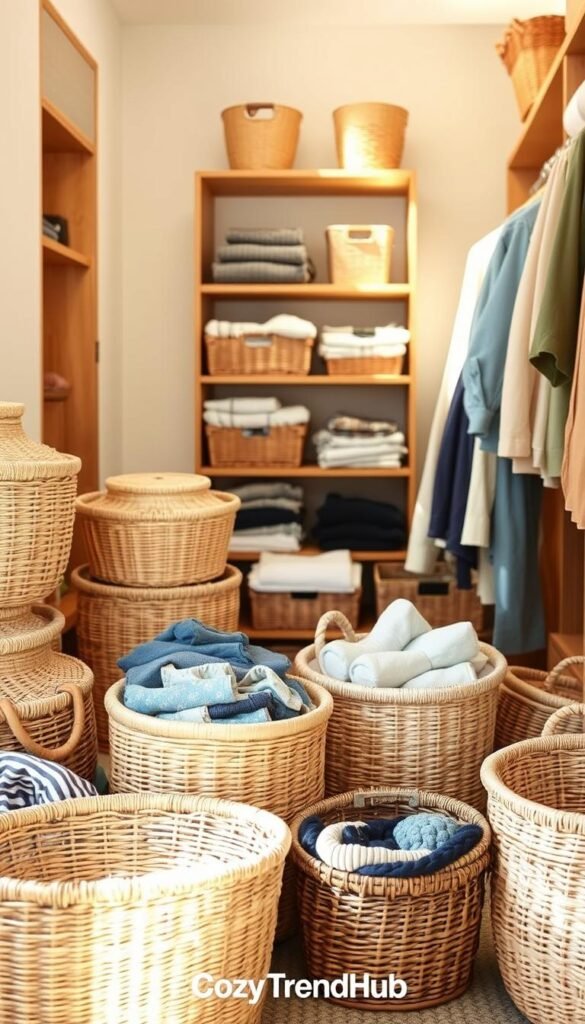
Woven natural fibers (rattan, wicker, seagrass)
What it solves: decorative open shelving and bulky linens.
Benefits: Warm look and good airflow. Lidded versions add dust protection for high shelves.
Watch for: weave quality varies; some weaves can snag delicate fabric.
Plastic crates and bins
These are lightweight, wipe-clean, and often stackable.
Good for renters: easy to reconfigure and water-safe—useful in laundry or bathrooms.
Fabric and cotton rope
What it solves: softness for textiles and flexible bedroom storage.
Benefits: Gentle on blankets and shirts. Choose sturdy stitching so the shape holds when carried.
Handles, lids, and stackability
Use lids for high shelves or dusty spots. Open tops speed daily grabs.
Handles make heavy bins easier to lift; choose comfortable grips for frequent use.
Stackability saves floor space but check that lids lock or vent if airflow is needed for linens.
Labeling that works
Tag-style labels on handles help after moves or swaps. Adhesive labels suit smooth plastic fronts.
Clear, short labels speed resets and cut extra pulls.
| Material | Best use | Key caution |
|---|---|---|
| Wire | Folded clothes, visibility | Snag risk; heavier |
| Woven natural | Open shelves, linens | Weave can vary; not water-safe |
| Plastic | Utility, laundry, renter moves | Can trap humidity if sealed |
| Fabric/rope | Soft textiles, bedrooms | May slump if poorly stitched |
Best closet baskets for shelves, floors, and linen closets
Picked for durability and everyday use, these five storage options fit shelves, floors, and linen closets.
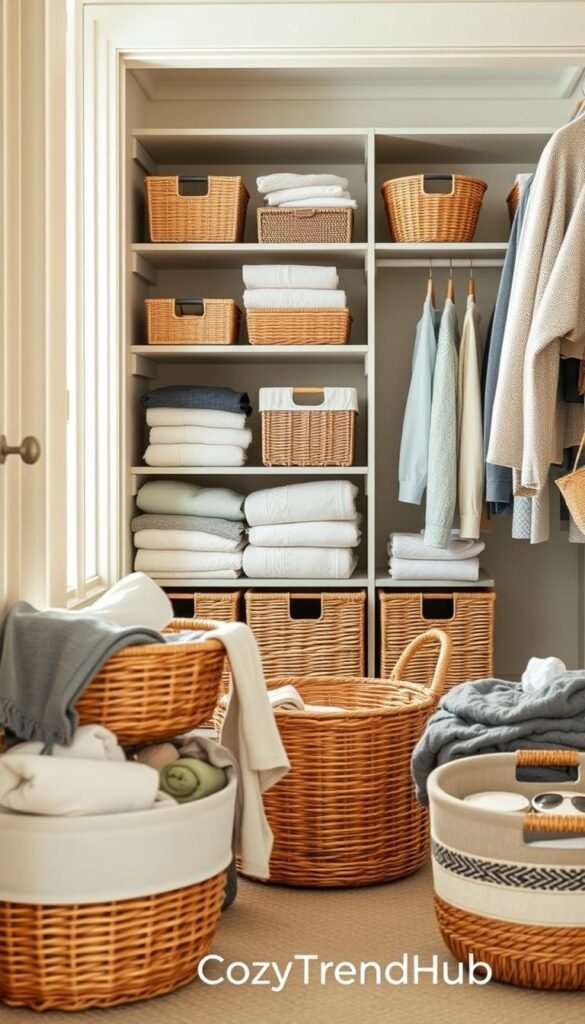
Hay Recycled Colour Crate — Best overall, versatile
Best for: renters who need a system that moves with them. Problem solved: stackability and open-front access for fast grabs.
Pros: collapses flat, optional lids/wheels, modular range. Cons: crate aesthetic may not suit ultra-minimal decor.
SmartStore Nordic Basket — Best airy option for linens
Best for: linen closets and bathroom-adjacent storage. Problem solved: airflow and light concealment.
Pros: perforated design, sturdy to drag, optional bamboo lid. Cons: lid is an extra cost.
Muji Stainless Steel Wire Basket — Best for folded clothes
Best for: people who want instant visibility. Problem solved: prevents toppled piles.
Pros: durable, seven sizes, swing handles for stacking. Cons: open wire shows contents, so neat folding helps.
| Material | Best use | Visibility | Lid | Handle comfort | Size range |
|---|---|---|---|---|---|
| Recycled plastic | All-purpose | Medium | Optional | Good | Multiple |
| Perforated plastic | Linens | Low | Optional | Sturdy | Few |
| Stainless wire | Folded clothes | High | No | Good | Seven sizes |
| Seagrass | Decorative storage | Low | No | Built-in | Limited |
| Cotton rope | Blankets/overflow | Low | No | Soft | Multiple |
How to choose the right closet baskets for your specific closet problem
A few well-chosen shapes solve most everyday storage headaches—pick by problem, not style. Below is a simple decision tree that links common issues to practical container shapes and materials. Use it to buy fewer, more useful items that move with you.
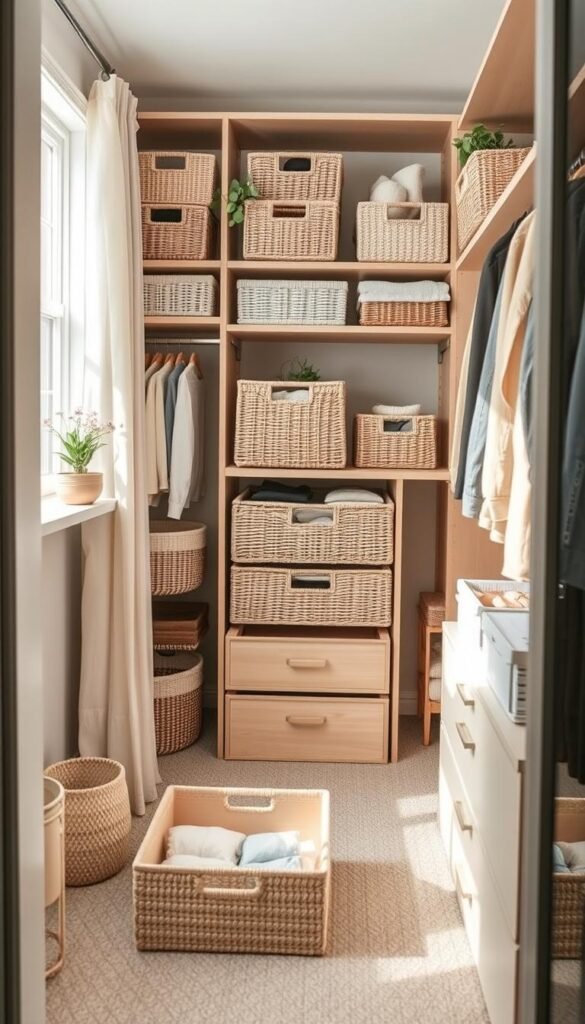
If stacks topple
Problem: folded clothes keep collapsing. Choose shallow, wide wire or low-sided bins that act like rails around stacks.
Pros: prevents toppling, keeps piles visible. Cons: open sides show contents so neat folding helps.
If you lose small items
Problem: scarves, belts, and small accessories migrate across shelves. Pick small category baskets with clear labels.
Tip: use identical color bins for visual calm and adhesive labels for fast resets.
If your closet pulls double duty
Problem: guest room or office shelves need to look tidy. Choose uniform, decorative containers that match shelf depth and repeat in size.
Benefit: consistent color and scale hide irregular contents while staying renter-friendly.
If you store heavy items
Problem: jeans, bulk toiletries, or tools warp cheap boxes. Pick rigid plastic or metal bins with comfortable handles for dragging and lifting.
Buy/Skip: buy rigid bins for heavy loads. Skip delicate weaves and lid-only access for daily items.
Best uses for baskets beyond the closet (so they won’t become clutter)
Repurposed storage keeps extras useful across rooms instead of adding clutter. Plan each basket’s primary zone and a fallback use so it earns its place in the home.
Entryway drop zone for shoes, hats, and gloves
Use a sturdy floor basket as a shoe drop near the door. It keeps daily footwear off the floor and speeds evening tidies.
Add a small labeled basket on a high shelf for hats and gloves. When the season ends, rotate those items into storage to free the entryway.
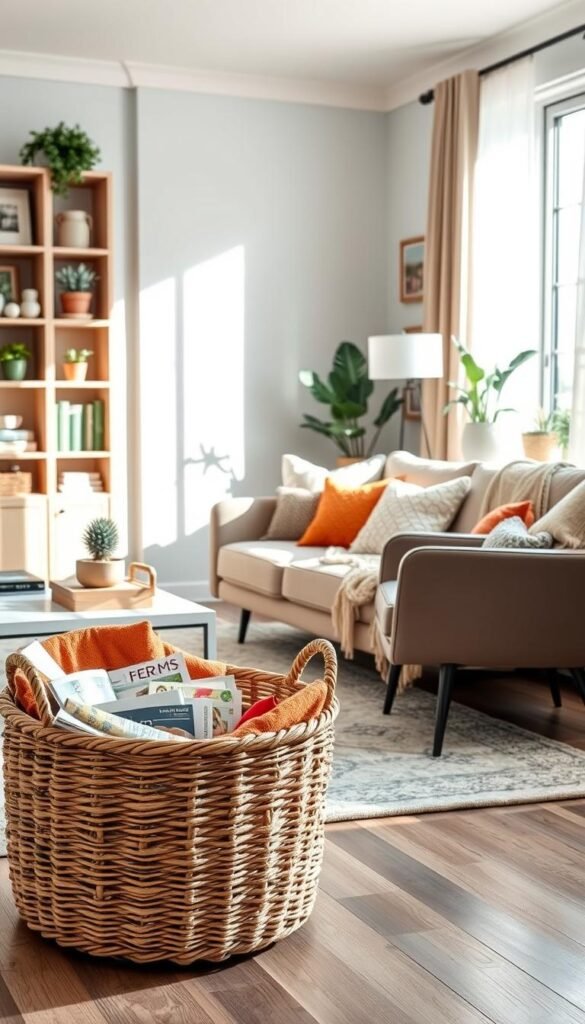
Living room storage for games, books, and throws
Keep one basket under a console table for remotes, chargers, and current games. A second one holds throw blankets for quick guest-ready looks.
Assign categories so a fast room reset is one or two lifts, not a scatter of containers across the room.
Bathroom grouping for towels, toilet paper, and guest toiletries
Choose medium woven or fabric baskets for backup towels and paper rolls. Use a separate basket for guest-ready toiletries so everything is grab-and-go.
Tip: avoid delicate natural fibers near damp spots. If moisture is present, pick water-safe materials or a wipeable basket instead.
Laundry and utility: water-safe choices for cleaning supplies
For cleaning bottles and wet items, pick durable, wipeable baskets made of plastic or coated fabric. They resist spills and are easy to sanitize.
Rotation tip: swap seasonal gear between entryway and bedroom baskets instead of buying new bins. Multi-room usefulness reduces waste and keeps storage functional.
Drawer inserts buying guide: what works for shallow drawers and deep drawers
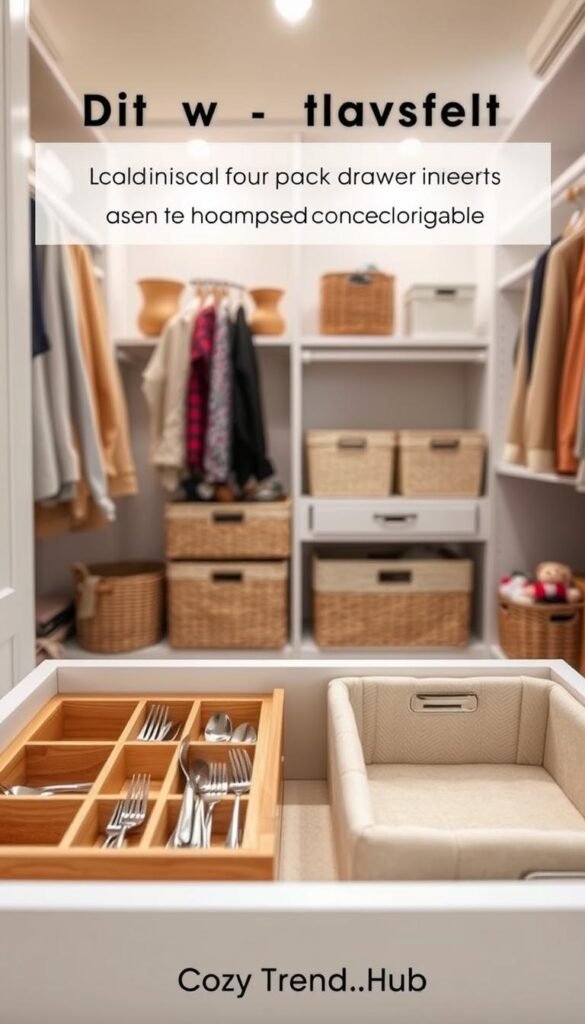
A good drawer insert turns a chaotic catch-all into a one-sweep reset. Drawer inserts are the high-frequency solution for makeup, cords, grooming, and office gear. They speed daily routines and cut friction.
Modular, clear organizers for visibility and fast resets
Choose modular clear systems made from thick-gauge plastic so pieces stack and nest. Clear trays reduce searching time and let users see contents at a glance.
Compartmentalizing “catch-all” drawers without wasting space
Measure internal drawer width, depth, and height before buying. Match modular sizes to fill the footprint rather than one large, wasted tray.
- Shallow drawers: low-profile trays and small compartments prevent tangling and keep items single-layered.
- Deep drawers: taller bins or stackable inserts stop the drawer from becoming a hidden pit.
What to prioritize for rental bathrooms and small bedrooms
For rentals pick wipe-clean plastic with non-slip bases and removable bins that lift out for quick counter cleaning. If a drawer looks busy, use fewer categories and stronger labels to keep visual calm.
Quick warning: avoid single-piece organizers that do not match drawer sizes — they create dead space and defeat the purpose of good organization.
For further reading on useful systems, see best drawer organizers and dividers.
Best drawer inserts for makeup, accessories, office supplies, and more
Here are the top drawer inserts that turn daily clutter into quick, one-pull resets.
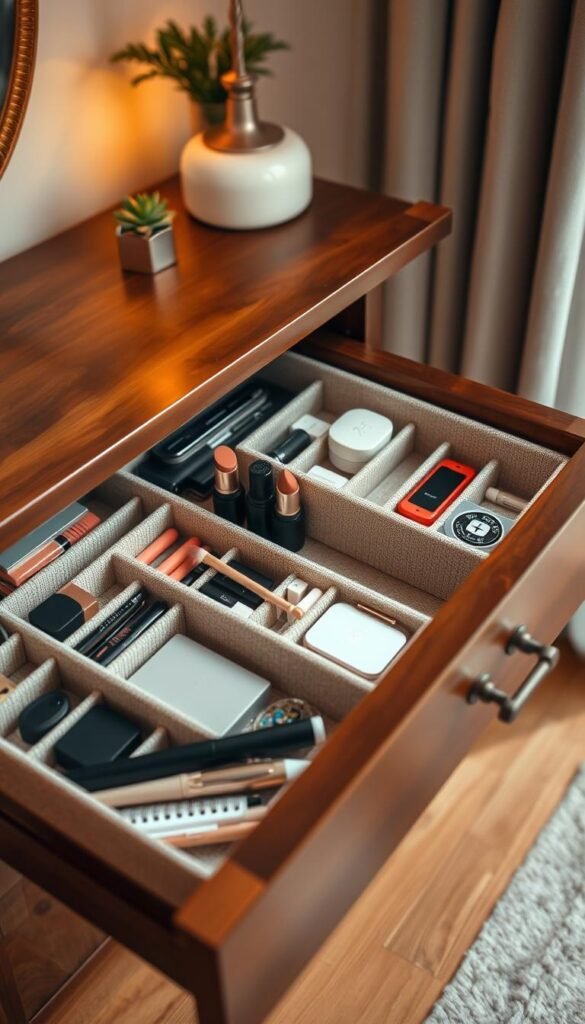
The Home Edit Modular All-Purpose Bin
Best for: people who want a clean, modular system for grooming, crafts, or office categories.
Problem solved: small items get grouped and stay visible.
Pros: thick clear plastic, stacks via a full lip, smooth handles for easy pull-out.
Cons: higher price than basic boxes.
The Container Store Shoe Box (small organizer)
Best for: budget-focused buyers needing many small organizers at once.
Problem solved: cheap, repeatable containers that make bulk sorting affordable.
Pros: cost-effective in sets, snap lids, clear visibility.
Cons: utility look over decorative finish.
The Container Store Sweater Box (larger bin)
Best for: bulkier categories like hair tools, backstock, or larger accessories.
Problem solved: provides room for bigger items that don’t fit small trays.
Pros: large capacity and stackable.
Cons: can invite overfilling if categories aren’t defined.
Hay Colour Crate (small)
Best for: flexible storage that moves from drawer to shelf as needs change.
Problem solved: portability and modular use across rooms.
Pros: lightweight, stackable, repurposable.
Cons: open sides show contents; neat grouping helps.
Crates & Pallet Unfinished Wood Crate
Best for: grab-and-go categories and low-plastic homes.
Problem solved: durable open-top access for frequent items.
Pros: sturdy and natural-feeling.
Cons: heavier than plastic and may need light sanding to avoid snags.
| Product | Best for | Footprint | Stackability | Visibility | Drawer → Shelf |
|---|---|---|---|---|---|
| The Home Edit Modular Bin | Grooming, crafts, office | Small–medium | High | High (clear) | Yes |
| Container Store Shoe Box | Budget multiples | Small | High | High (clear) | Limited |
| Sweater Box | Bulkier categories | Large | High | Medium | Yes |
| Hay Colour Crate | Flexible moves | Small | Medium | Low–Medium | Yes |
| Wooden Crate | Open-top grab | Medium | Low | Low | Yes |
For budget-friendly product picks and more affordable storage options to buy in multiples, see this short guide at best budget organization products.
When to pick drawer inserts vs. closet baskets (and when to use both)
Choosing between drawer organizers and open storage comes down to frequency, size, and access. Use inserts for daily small items; use baskets for bulky or seasonal categories. This rule reduces overbuying and keeps routines simple.
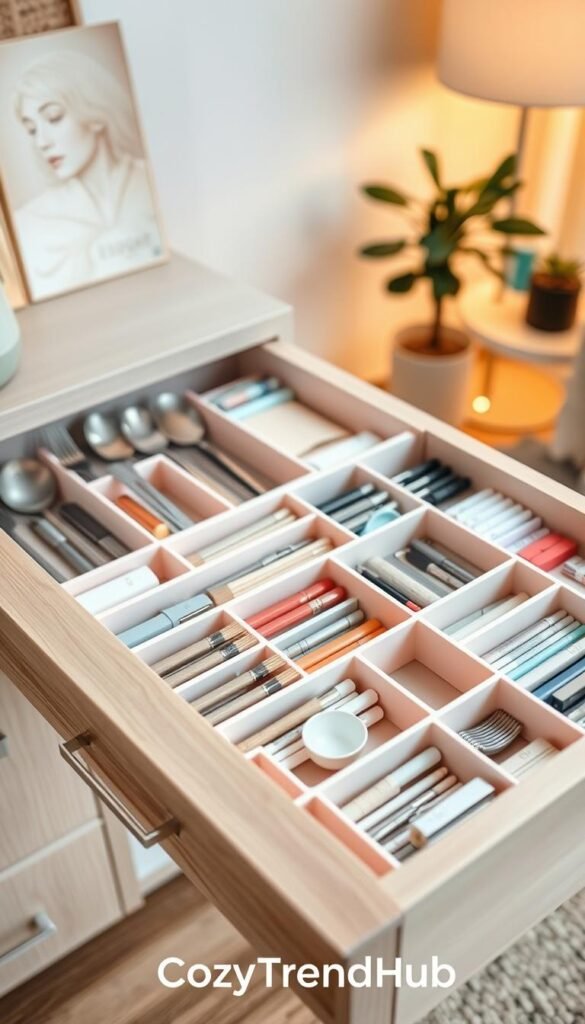
Simple rule: drawer inserts suit high-frequency items you pull every day. Use an insert for socks, jewelry, and small grooming items so each thing stays visible and separated.
When to use open bins: pick a bin for towels, folded linens, or seasonal outerwear. These hold bulk and keep shelf stacks neat without daily touch-ups.
Create a one-step cleanup
One-step cleanup means one motion puts an item away without refolding or opening another box. Add open-top dump zones with clear labels so quick tosses stay sorted.
- Combine both: inserts inside drawers for small daily items; open bins above for seasonal gear.
- Avoid too many micro-bins — they add friction and invite overflow piles.
- For renters: a mixed system adapts when drawer sizes change after a move.
Quick buyer checklist: frequency of use, item size, visibility needs, and dust protection. When unsure, choose one removable insert and one stackable bin to test the routine before buying multiples.
Decide between drawers and shelving if you need a deeper guide on matching hardware and storage types.
Small-space and renter-friendly setup tips that make storage stay organized
Small changes create routines that last. Start with a practical plan and a few repeatable steps so storage becomes habit, not a project.
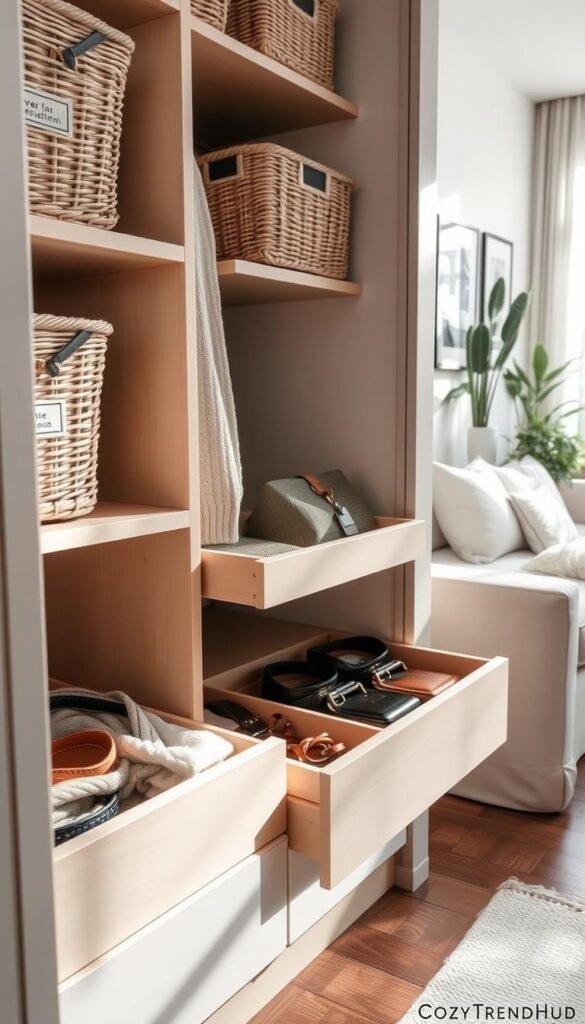
Assign by category for predictable places
Sort by how you use items: tops, bottoms, shoes, scarves, and accessories. This matches the way people think and speeds decision-making when dressing or packing.
Use identical containers to reduce visual noise
Pick a single style and color for open shelving. Uniform fronts create calm and make gaps or misplaced items obvious at a glance.
Keep a grab basket by the door
Place one small basket near the entry for keys, masks, and transit items. It prevents daily essentials from migrating to counters and chairs.
Step-by-step setup
- 1) Purge by category: remove what you don’t use.
- 2) Measure the shelf or drawer depth and height.
- 3) Buy fewer, repeatable basket sizes that stack or slide easily.
- 4) Label before filling so content is obvious and stays sorted.
Make labels movable: use tag labels on handles so relabeling after seasonal shifts or a move is fast and damage-free.
Maintenance routine
Once a week, reset only the overflow basket(s). A small weekly habit prevents full reorganizations and keeps the system working.
Make sure the most-used categories sit at eye level and rarely-used items go high. For quick ideas on entryway zones and daily drop areas see a short guide to entryway organization at best entryway organization ideas, or browse tested recommendations for broader organizing approaches at closet organizing ideas.
Seasonal and under-bed storage strategies that pair well with closet baskets
A well-chosen under-bed solution turns wasted floor space into an organized seasonal system. Use under-bed storage for off-season clothes, spare blankets, and items used only a few times a year.
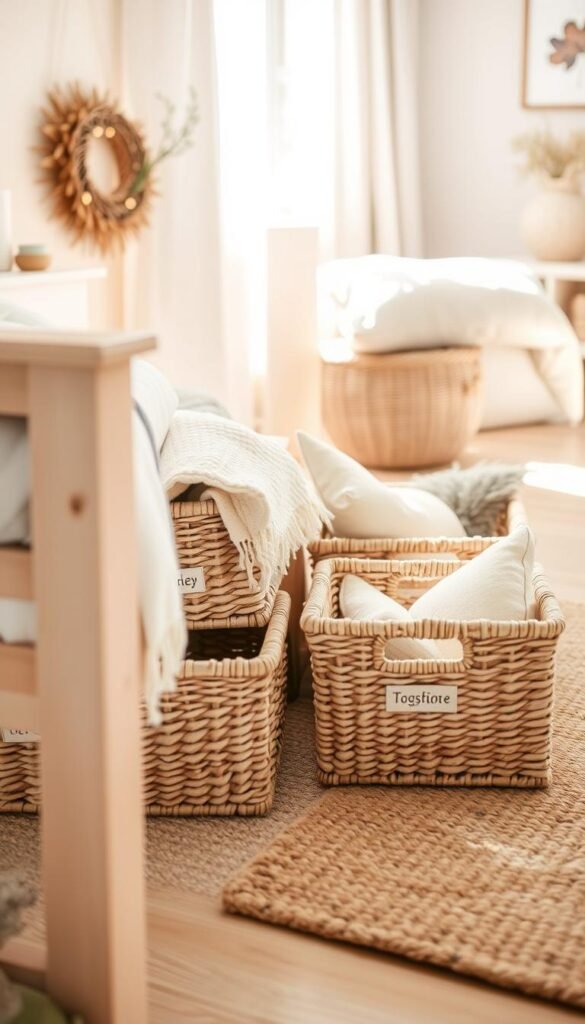
Ikea Skubb Storage Case — best for soft goods that need airflow
The Ikea Skubb is a zip-closed fabric case with a polypropylene insert and mesh corners for breathability. It has a handle that makes moves easy for renters.
Pros: light, ventilated, and packs soft clothes without crushing them. Cons: overfilling can make the bag bow and reduce shelf fit.
Low-clearance option: The Container Store Boot Box
This low-profile hard box fits tight frames and offers a snap lid for quick access. It works well where bed clearance is shallow and a rigid shape is needed.
Pros: durable plastic, easy slide, neat stackability. Cons: less flexible for odd-shaped items than fabric bags.
When a tighter seal matters: The Container Store Weathertight Tote
The Weathertight Tote has a latching lid and foam seal to keep out moisture, dust, and pests. Sizes often sell in cases, which is useful when buying multiples.
Pros: excellent long-term protection for heirloom clothes and seasonal gear. Cons: bulkier and heavier, so it may be more than needed for short rotations.
Seasonal rotation method: pack by category — heavy sweaters, scarves, and one spare set of bedding per box or bag. Label both long sides so contents read easily when slid under the bed.
- Keep in-season items in eye-level baskets for daily use and move off-season containers under the bed.
- For renters, choose lightweight bags or labeled boxes that travel well at move time.
- Balance airflow (Skubb) versus seal (Weathertight) depending on whether items need ventilation or protection.
For tips on seasonal packing and care, see a practical seasonal storage guide at seasonal clothing storage tips and more organization ideas at best closet organization ideas.
Comparison criteria to use before you click “add to cart”
A quick checklist helps you weigh airflow, visibility, and long-term value before checkout. Use these points to compare products side-by-side and buy with confidence.
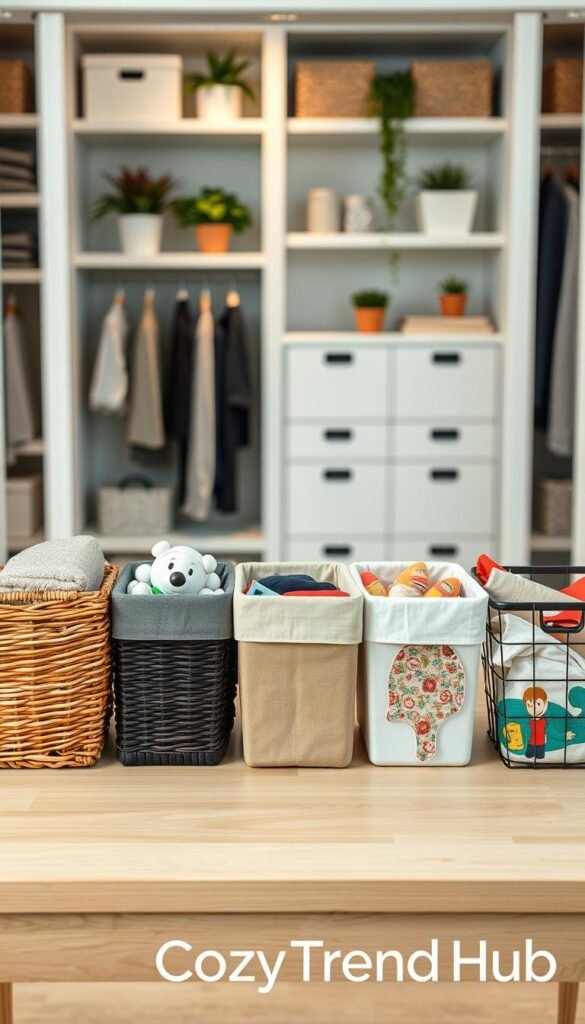
Airflow vs. dust protection
Airflow: Choose perforated or wire options for towels and linens to prevent mildew.
Dust protection: Pick lidded bins for under-bed or high shelves where dust settles.
Visibility vs. hiding visual clutter
Visible: Clear or mesh containers speed daily access.
Hidden: Opaque containers reduce visual noise but need labels so contents aren’t forgotten.
Size range and future moves
Prefer systems that offer multiple sizes and modular fits. A consistent size range adapts to new shelves and reduces the chance of returns due to wrong height.
Value when buying multiples
Buying sets or cases cuts the per-item price and keeps a uniform look. Match repeatable sizing so extra storage aligns with existing pieces.
- Pre-purchase checklist: usable height, depth, handle comfort, lid fit, and price per unit.
- Return risk reminder: wrong height is the most common failure—measure before you order.
- Decision shortcut: pick one open system for shelves and one clear insert system for drawers to keep the look cohesive.
For matching options that work well in small rentals, see best closet organizers for small closets.
Conclusion
Conclusion
Start small: measure one problem shelf and one drawer, then solve them completely before buying more.
Clutter stays gone longer when each category gets a defined container-sized boundary and a simple reset routine. Match the product to the need: crates for flexible shelf-to-room use, perforated bins for airflow, wire for visible, stable folded stacks, seagrass or rope for softer decor, and clear drawer inserts for high-frequency small items.
Label immediately so opaque bins don’t become mystery boxes. Choose portable, modular pieces that move with a renter and can be repurposed in a new home.
Quick habit: a two-minute weekly reset of one overflow basket and one catch-all drawer keeps the system working. Use the checklist in Section 14 to pick the right storage product and then buy multiples to keep sizing consistent. For more tested options, see the best storage bins.

One Comment