
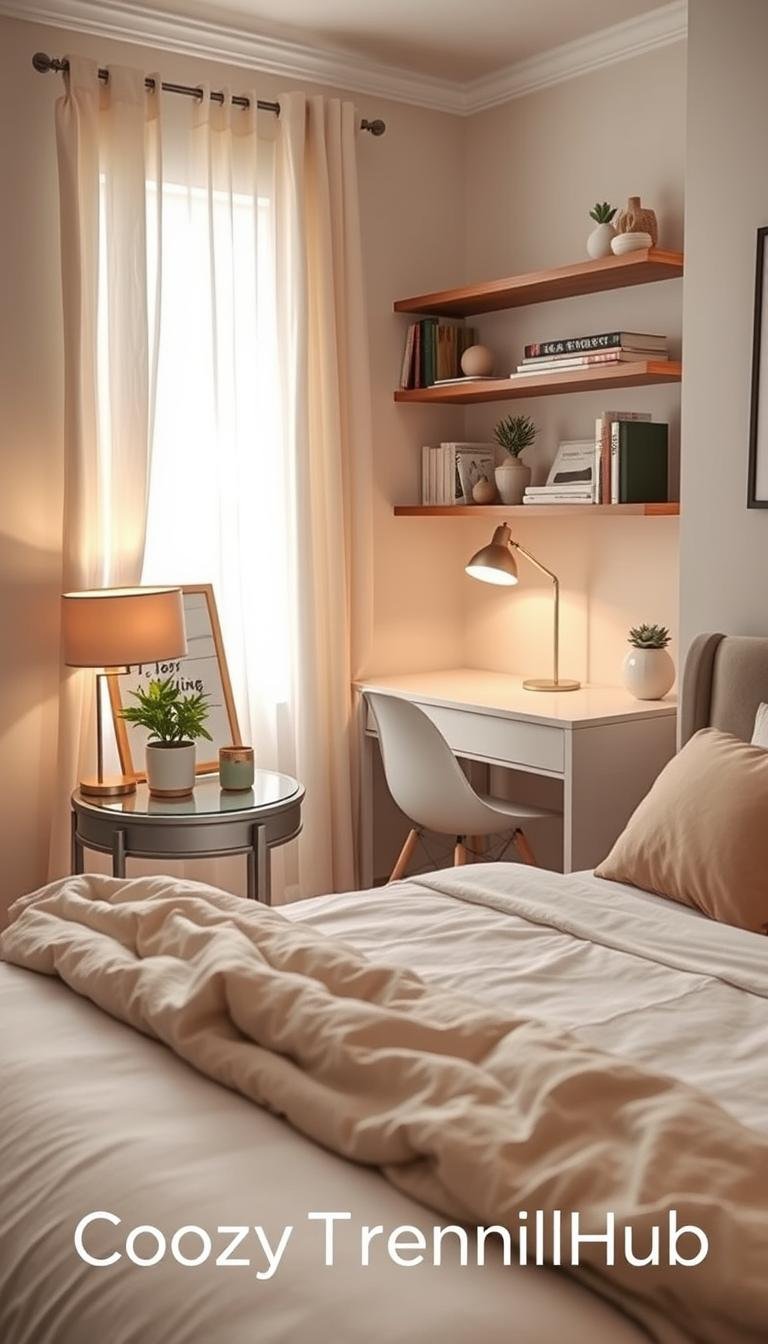
Living in a compact room often feels like a puzzle. Limited floor area, crowded pathways, tight bedside surfaces, and storage that overwhelms the eye are common pain points. This introduction frames those problems and points to clear fixes.
The list below offers five focused solutions to make a small bedroom feel intentional and calm. Each idea includes best for notes, key buying considerations, and quick pros and cons. The article takes a buyer-focused approach so readers can match solutions to needs.
Design editors often recommend wall-mounted lighting, full-width drapery behind a bed near a window, daybeds for dual seating and sleep, Murphy beds to reclaim daily floor area, and Roman shades to reduce window bulk. Renter-friendly options get priority: plug-in lighting, removable wall treatments, modular storage, and non-permanent window solutions.
Later sections include comparison tables (for example, Murphy bed vs daybed) and affiliate picks with what to check before buying. Quick tip: start by diagnosing your biggest issue—storage, light, layout, or visual clutter—then jump to the matching section for targeted solutions.
Key Takeaways
- Identify the main pain point first to pick the right solution.
- Each idea lists who it’s best for and what to check before purchase.
- Renter-friendly fixes like plug-in lights and removable treatments are prioritized.
- Five space savers focus on reclaiming usable floor and visual calm.
- Comparison tables and affiliate picks help compare options quickly.
Start Here: Fix the Most Common Small Bedroom Problems
Measure once, then design: practical choices beat pretty pictures when space is tight.
Choose a bed size that fits your floor space
The bed dominates the layout. Picking queen vs king often decides whether nightstands fit and doors or drawers can open. Measure the mattress footprint, then add 24–30 inches per side for circulation.
Prioritize flow with fewer, multifunctional pieces
Use a dresser as a bedside surface or a desk that doubles as a night table. These swaps keep floor area clear and make walking paths easier to maintain.
Use vertical solutions on walls
Install floating shelves, plug-in sconces, or a modular rail to move frequently used items off the floor and into reach on the wall. This reduces visual clutter and frees up floor storage.
Layer lighting early
Combine sconces, a table lamp, and soft ambient light. Layered light makes the room feel larger than a single overhead fixture.
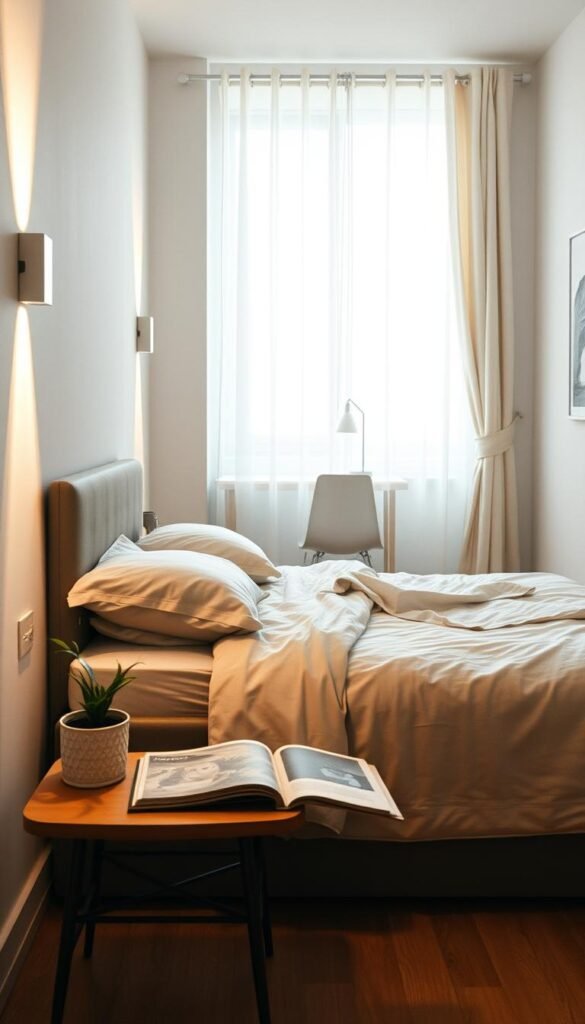
| Problem | Quick Fix | Renter-Friendly Option | Where to Read More |
|---|---|---|---|
| Bed too big | Downsize footprint or choose platform frame | Use a lightweight frame that disassembles | aesthetic solutions for tight spaces |
| Cluttered floor | Wall shelves + floating night table | Plug-in wall sconces and removable hooks | Section on wall systems |
| Poor lighting | Layer sconces, lamps, ambient | Plug-in sconces with adhesive anchors | Lighting section |
Small Bedroom Decor That Makes the Room Feel Larger (Without Renovations)
Small upgrades in layout and finish can trick the eye into a room that feel larger without moving a wall. These tactics focus on perceived height, continuity, and brightness so the space feel more open and calm.
Go low: a lower bed frame can make the ceiling feel higher
A low platform draws the sightline up toward the ceiling, which gives a taller effect. Best for rooms with standard ceilings and large mattresses.
Shop for platform height and check under-bed storage needs before buying.
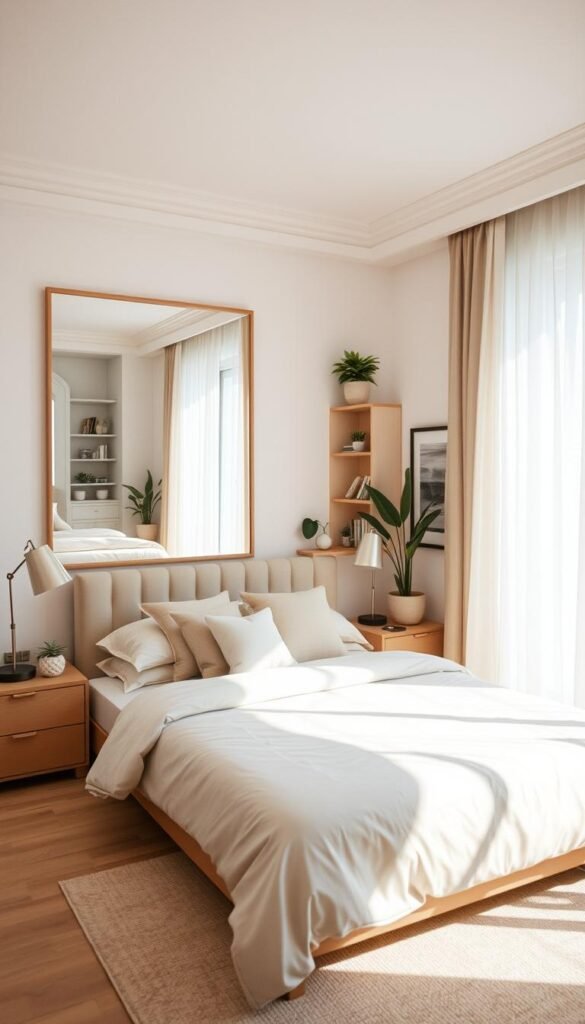
Pattern-drenching and tonal styling as an optical illusion
Wrapping one print across walls, curtains, or bedding keeps the eye moving and creates an illusion of cohesion. Use matching tones so the pattern reads as one continuous surface.
Buy coordinated textiles and avoid high-contrast mixes that chop the visual field.
Reflective finishes to bounce light around tight spaces
Mirrored trays, a glossy nightstand, or metallic sconce backplates amplify natural and lamp light. In thoughtful design, reflections increase perceived brightness and depth.
When a dark color palette makes a small room feel intentional
Deep color or paint can create a cocooned, sophisticated mood for those who prefer cozy. Pair texture and layered lighting to prevent flatness.
Buyer warning: avoid over-accessorizing—visual noise will make small spaces feel cluttered instead of larger. Later sections cover lighting, window treatments, and storage to help make room feel roomy and functional.
Best For Renters: Add Wall Sconces to Free Up Nightstand Space
Wall sconces reclaim tabletop real estate and sharpen bedside function. Bedside lamps often take up the only usable surface on nightstands and create clutter. Mounting the light to the wall moves illumination off the table and frees that surface for essentials.
Who benefits: renters who can’t alter furniture footprints, couples sharing one tight bedside surface, and anyone who reads in bed.
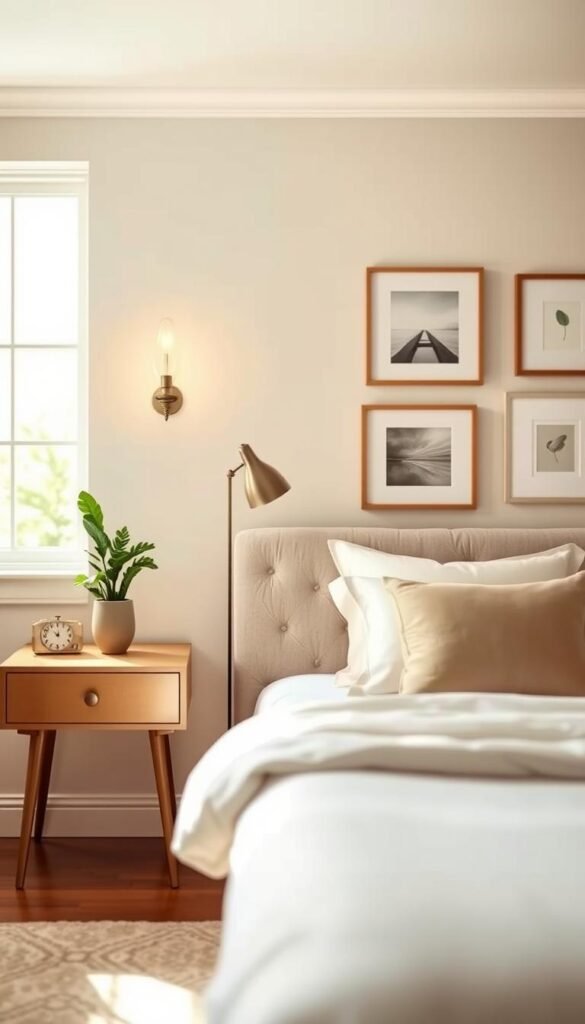
Buying and installation checks
- Hardwired vs plug-in: plug-in models suit most apartments and avoid landlord permissions; hardwired gives a cleaner look if allowed.
- Reach and aim: pick a swing-arm or adjustable head so the light falls over the pillow for reading.
- Bulb tone: warm bulbs feel cozy; neutral white is better for task light—choose dimmable bulbs where possible.
- Cord management: use paintable cord covers on walls or tuck cords behind nightstands for a tidy install.
Pros and cons
- Pros: cleaner surfaces, more usable floor and surface space, flexible light placement.
- Cons: mounting limits (studs, landlord rules), and switch or routing planning is required.
Space-saving bedside lighting picks
| Type | Best for | Feature to look for |
|---|---|---|
| Plug-in swing-arm | renters | adjustable arm, inline switch |
| Compact flush sconce | tight walls | low profile, LED lamp |
| Adjustable reading sconce | couples | directional head, dimmable |
Create a Cocoon Feel With Full-Width Drapery Behind the Bed
When a bed sits tight against a window, the wall often reads unfinished. A continuous drapery treatment fixes that and makes the sleeping zone feel deliberate and calm.
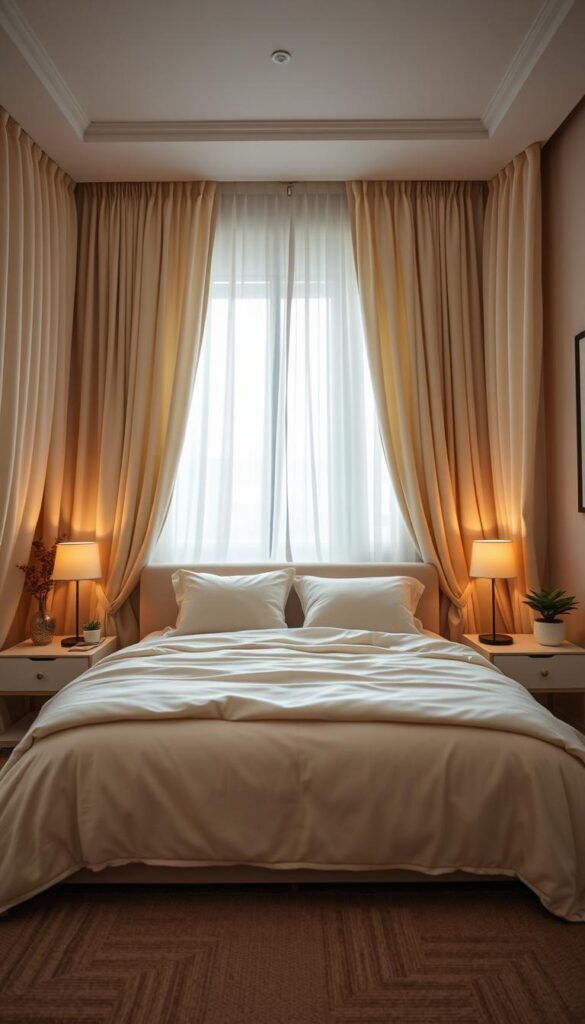
Why it works: extending curtains across the full width of the room creates a unified backdrop. The effect is a softer focal wall that hides awkward window alignment and visually widens the area.
Buying considerations
- Width: aim for 1.5–2.5x the window width for proper fullness.
- Rod placement: mount wider than the window and higher than the frame to expand the view.
- Fabric: light-filtering fabrics for daytime softness; blackout for better sleep in an apartment.
Best for renters: this solution delivers big impact without swapping furniture. Choose plug-in or minimal-mount hardware if holes are a concern.
Pros: adds softness, hides misaligned windows, and builds a cocooned feel. Cons: can bulk corners and block radiators if not measured.
Keep bedding tonal and simple so the drapery reads as a backdrop. For more ideas on cohesive finishes and product picks see aesthetic home decor.
Make the Bed Wall Do More With an Extended Headboard Look
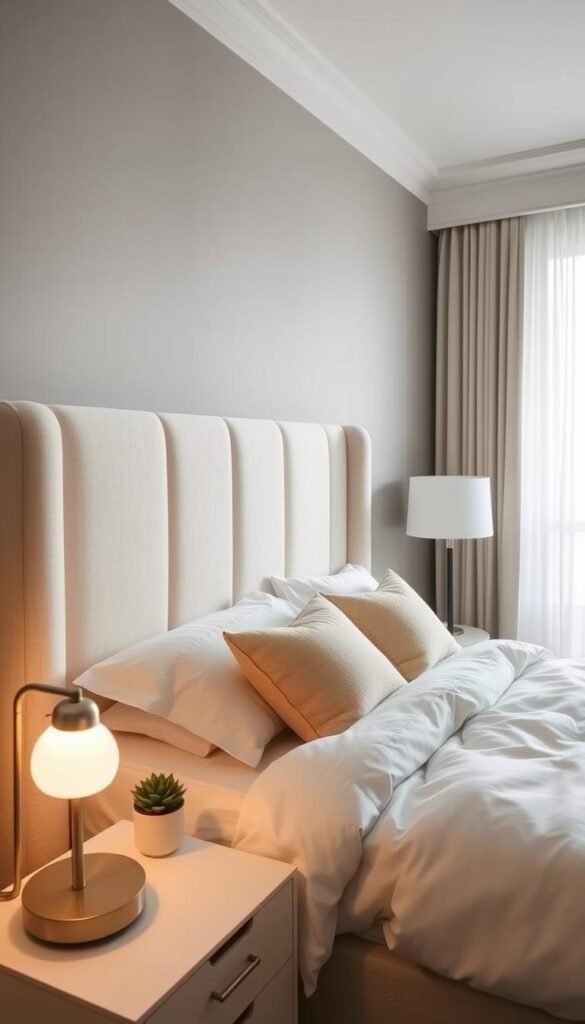
A broad headboard line can make a tight wall read as intentional design rather than a cramped barrier.
Problem it solves: In a narrow room the bed wall often makes the entire space feel tighter. Extending the headboard visually spreads the focus across the wall, so the room feels wider and less dominated by the mattress.
Best for
This approach works well in New York rentals and other compact urban units where the bed dominates and there’s little side clearance.
Renter-friendly ways to fake a wall-spanning headboard
- Upholstered wall panels mounted with removable, weight-rated strips for a soft, anchored look.
- Peel-and-stick wall treatment that mimics wood or fabric—easy to remove at move-out.
- Fabric stretched over lightweight boards hung as a continuous band for texture without heavy fasteners.
Buying considerations and tradeoffs
- Panel thickness: avoid deep pieces that block circulation or hit door swings.
- Cleanable fabrics and stain-resistant finishes for long-term wear.
- Plan for integrated lighting if you want sconces—check mounting and wiring needs.
„Extending the headboard line horizontally shifts attention away from limited floor space and creates a lasting illusion of width.“
Pros: a finished, cohesive wall that can replace several art pieces and makes the room feel wider. Cons: added cost, careful alignment during install, and extra work at move-out if repairs are needed.
Practical way to keep the effect strong: limit bedside pieces so the extended headboard stays the focal point rather than competing with clutter.
Reduce Visual Clutter With Miniature Art and Right-Scale Decor Pieces
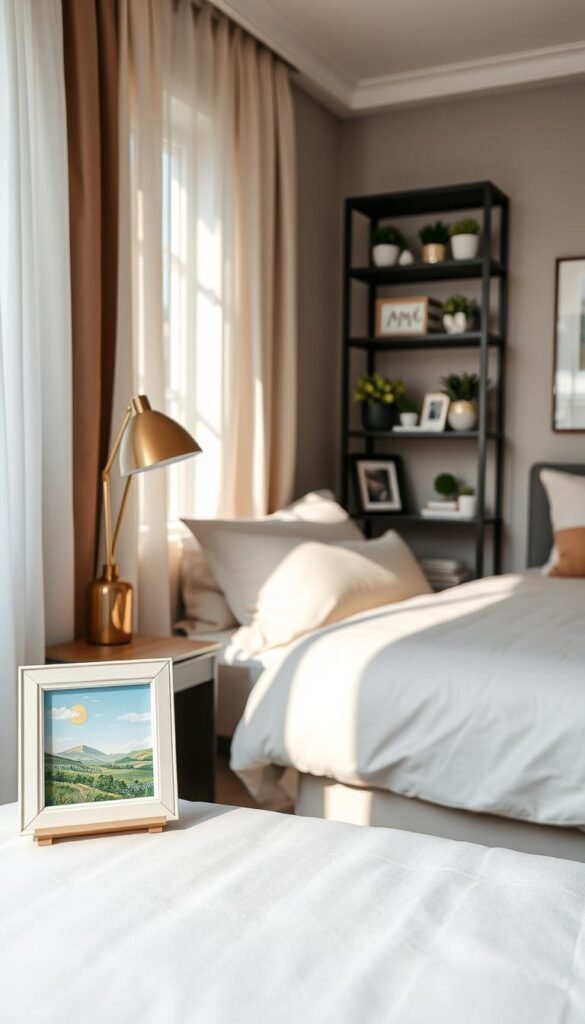
Choosing the right scale for wall pieces restores balance to a cramped layout. Crowded walls and oversized frames overwhelm a room and shorten sightlines. Simple, smaller art keeps the eye moving and frees negative space to work for the design.
Problem it solves
Crowded walls make a small bedroom feel busy even when storage is handled. Heavy frames and uneven spacing add visual noise.
Best for
This approach suits minimalists, renters who want lightweight hanging, and anyone sensitive to clutter.
Buying considerations
- Frame depth: choose shallow frames that sit close to the wall.
- Matting: a small mat adds breathing room around pieces.
- Gallery spacing: keep consistent gaps to avoid a scattered look.
- Hanging method: removable picture strips or wall-safe hooks rated to weight.
Pros: a calmer room feel, easy seasonal swaps, and less risk of making the walls read full. Cons: less single-piece drama; it can take planning to look intentional rather than sparse.
Tip: if a statement is preferred, pick one thin-framed focal piece rather than many medium pieces to make room feel curated and restore a quiet sense in the space.
Go Multifunctional With a Daybed or Lounge-Ready Setup
A daybed turns a single piece of furniture into both seating and sleep without crowding the floor. It solves the common problem of needing lounging, work, and guest space in one compact layout.
Problem it solves: the room must support lounging, working, or hosting but has no space for a separate chair plus a full bed footprint.
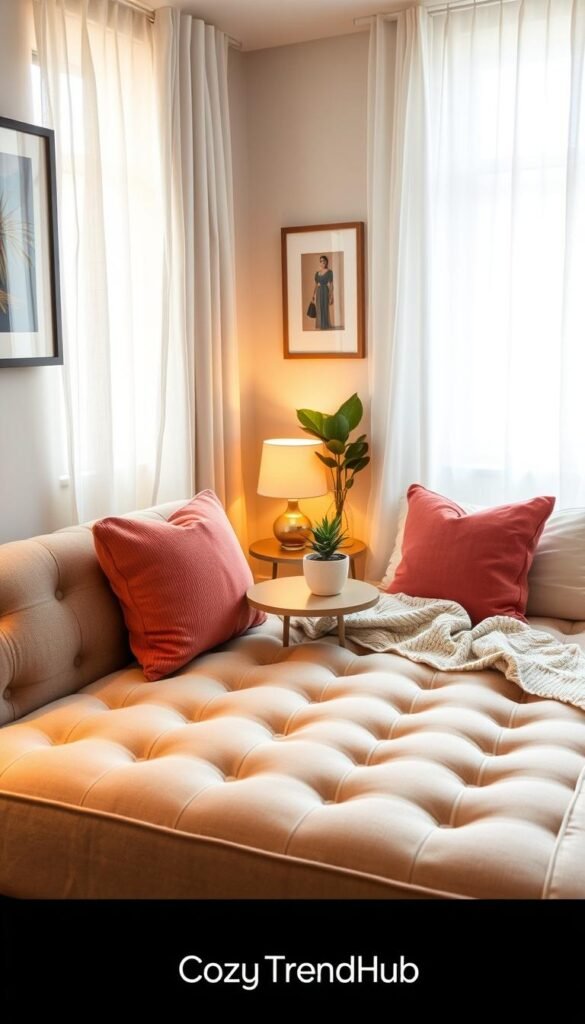
Why a daybed works: it reads like a sofa by day and becomes a comfortable sleep surface at night. Trundles add an extra guest bed without permanent bulk.
Best for: studio apartments, guest rooms that double as offices, and work-from-home bedrooms where daytime mode matters.
Buying considerations: mattress thickness for comfort and frame fit, back and arm support for real seating, and removable slipcovers for easy cleaning and seasonal swaps.
Styling tip: anchor the lounge zone with a scaled rug and layered pillows to avoid a dorm look. Look for frames with integrated storage and check clearance so any drawers open into a walkable way.
| Type | Footprint | Seating Value | Guest Capacity | Storage |
|---|---|---|---|---|
| Daybed | Compact | High | 1–2 (with trundle) | Often drawers |
| Standard bed | Large | Low | 1–2 | Under-bed possible |
| Trundle | Small extra | Low (sleep only) | +1 guest | None |
Pros: flexible daytime use and fewer added pieces. Cons: some couples may find width limiting and certain mattresses are required for specific frames.
Turn an Awkward Alcove Into a Layout Advantage
An awkward alcove can become the room’s most useful corner when planned as a purpose-built zone.
Slanted ceilings and tight nooks often steal usable area and make standard furniture placements feel forced.
The fix is to treat the alcove like a built-in: fit a low bed or bench, add slim storage under eaves, and keep the main walking path clear.
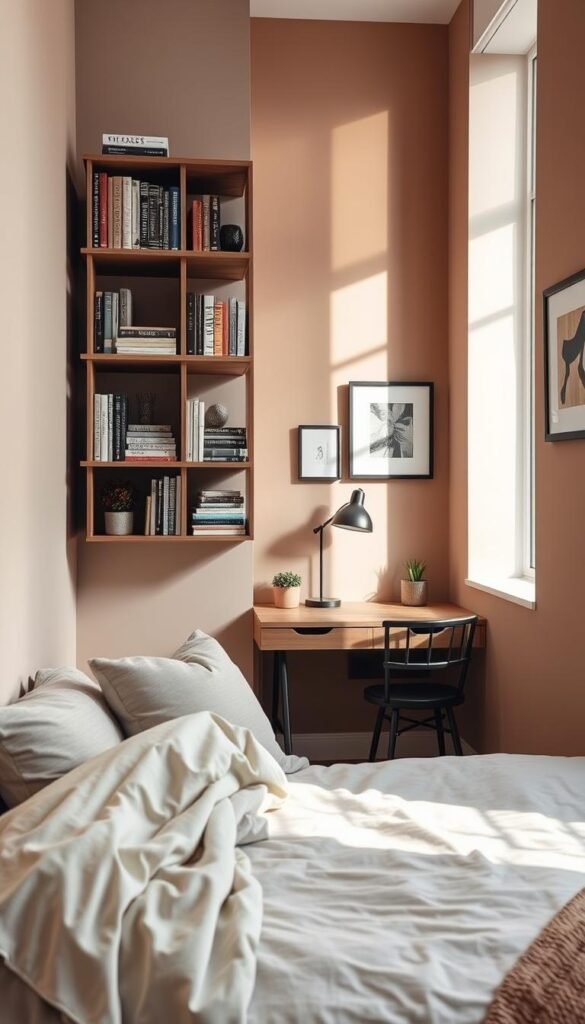
- Best for: attic rooms, converted spaces, and compact apartment layouts where every inch must earn its place.
- What to buy: under-eave drawers, plug-in wall sconces, and low-profile tables that tuck beneath slopes.
- Measure: confirm head clearance where the bed or seating will be used, not just where it technically fits.
- Renter tip: choose modular storage that moves with you and plug-in lighting if hardwiring isn’t allowed.
„Design around the slope and the alcove stops being dead space; it becomes a tailored zone that frees the rest of the floor.“
| Problem | Solution | Renter-Friendly Buy |
|---|---|---|
| Low eave that blocks cabinets | Short drawers under eave | Modular cube units |
| Sloped wall blocks lamp | Wall-mounted lighting | Plug-in swing sconce |
| Nook feels wasted | Low-profile daybed or desk | Collapsible desk |
Keep finishes tonal and simple so the odd architecture reads intentional. The outcome: the nook becomes a purpose-built area that frees floor space and simplifies the rest of the room.
For styling and product picks that pair with these layout moves, see best cozy bedroom decor.
Space Saver: Consider a Murphy Bed When You Need the Room to Do Double Duty
When daily living needs outgrow a permanent mattress footprint, a Murphy bed restores usable floor quickly. Design editors call it one of the biggest space maximizers when a room must double as an office, media area, or den.
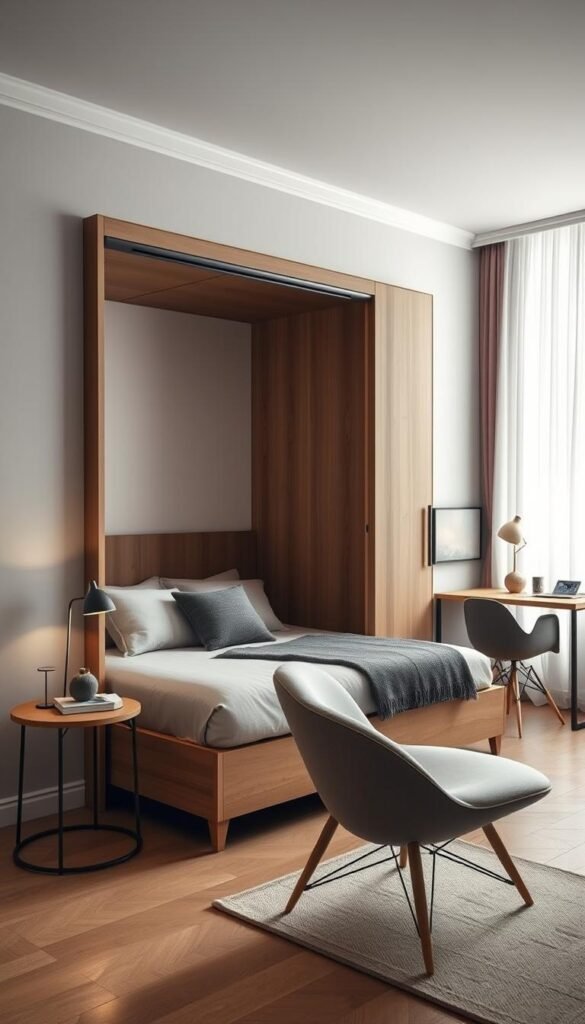
What problem it solves
The issue: a fixed bed footprint blocks daily use as work or living space. A wall-mounted option tucks away the mattress and reclaims floor space instantly.
Buying and safety checklist
- Choose: ready-made unit for faster install or custom for fit and finish.
- Wall requirements: solid studs or load-bearing backing and sufficient ceiling height.
- Costs: include professional install and hardware—expect higher upfront spend.
- Safety checks: smooth lift, reliable locking, and bedding compatibility when folded.
Pros and cons
- Pros: maximum daily floor space recovery and a tidy daytime look.
- Cons: higher investment, installation complexity, and less portability for renters.
„A Murphy bed lets one piece of furniture work as both bed and living area without compromise.“
Affiliate picks: plan a short list for ready-made frames, hardware kits, and Murphy+desk combos. For more space-saver ideas and installation tips, see practical space savers.
Space Saver: Choose a Storage Bed When Under-Bed Drawers Won’t Open
Tight side clearance often turns attractive under-bed drawers into unusable features. That frustration is common when a mattress sits close to a wall or nightstand.
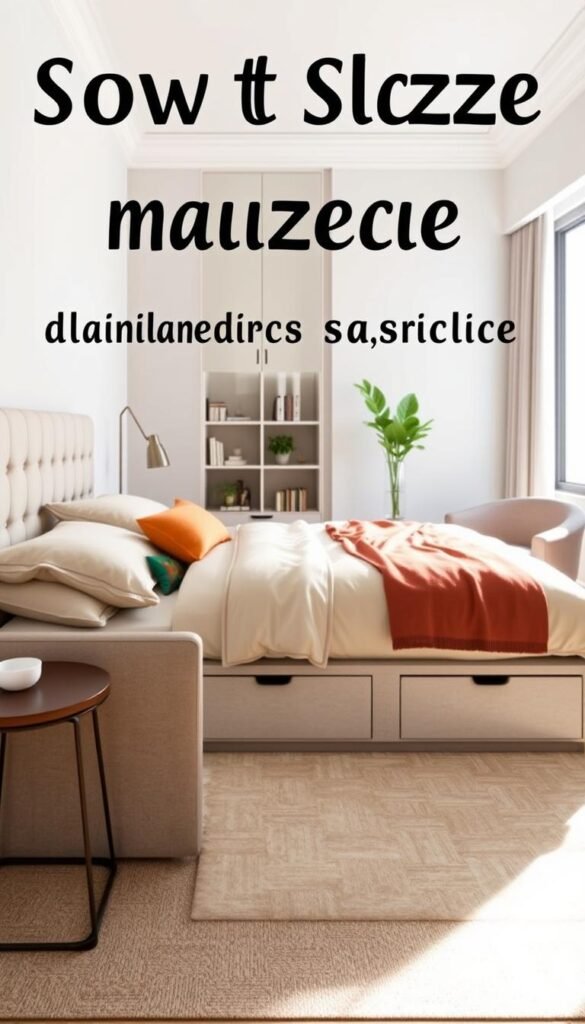
Why a pop-up storage bed helps: a lift-up base provides large hidden storage without needing drawer swing. Designers note models like West Elm’s Myla Pop-Up Storage Bed outperform drawer units in cramped layouts.
Problem it solves
No closet space and no clearance for drawer-style storage beds. A pop-up unit gives access from the top so contents stay reachable even with tight sides.
Best for
Couples sharing limited closet room who need to store double the belongings in one bedroom.
Buying considerations
- Pop-up lift vs drawers: choose lifts when side access is limited.
- Mattress weight: confirm the lift supports thicker mattresses.
- Gas-lift quality: smooth, durable hardware reduces strain.
- Top access: ensure you can clear the surface to raise the lid easily.
Pros and cons
- Pros: large hidden storage volume and a cleaner look that preserves floor space.
- Cons: heavier lift mechanisms, higher price, and the need to keep the top surface clear for access.
„Pop-up storage beds can reclaim usable space where drawers simply won’t fit.“
Affiliate picks: pop-up storage bed options
| Budget | Lift Ease | Profile |
|---|---|---|
| Value models | Moderate | Higher frame |
| Mid-range (e.g., Myla) | Smooth gas lift | Balanced height |
| Premium | Effortless lift, heavy duty | Lower profile for visual openness |
Space Saver: Build Storage Into the Wall (or Fake It With Modular Systems)
A wall-focused storage strategy reclaims usable floor and simplifies the plan. Built-ins remove the visual bulk of freestanding units and keep paths clear.
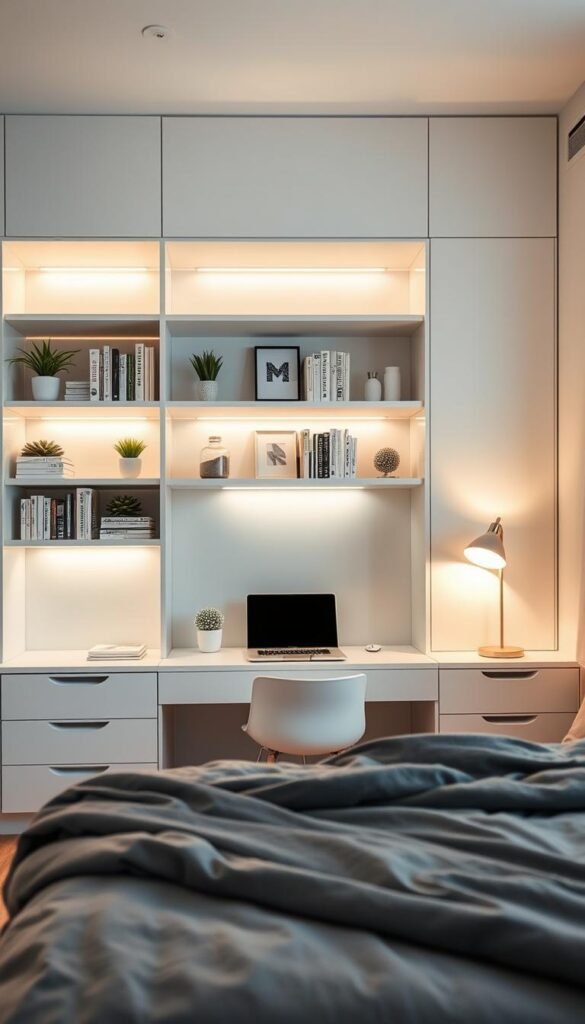
Problem it solves
Freestanding shelves and bookcases often block walking paths and make the room feel narrower. Recessed or wall-mounted options keep the floor open and improve flow.
Best for
- Homeowners: recessed or built-in shelving for permanent capacity and a finished look.
- Renters: modular systems anchored with wall-safe hardware that mimic built-ins and remove at move-out.
Buying considerations
- Shelf depth: choose shallow shelves to avoid eating into floor space.
- Stud placement and anchor ratings: match system weight to wall structure.
- Radiators/vents: plan covers or integrate vent spacing so heat and airflow aren’t blocked.
- Installation complexity: built-ins need trades; modular systems need careful anchoring.
Pros and cons
- Pros: maximum storage with less visual and physical crowding, better room flow.
- Cons: higher install effort, possible patching at move-out, and the need to avoid utilities and heat sources.
What belongs here: books, curated display pieces, and contained storage boxes to keep visual clutter low.
Decision note: if storage is the primary pain point and keeping the floor open matters most, built-ins deliver the biggest payoff. For renters wanting the same look, a well-anchored modular system is the practical alternative—see a set of renter-friendly ideas for built-in style storage.
| Approach | Best for | Impact on floor | Install effort |
|---|---|---|---|
| Recessed built-ins | Homeowners | High (no floor footprint) | High (carpentry + permits) |
| Modular systems | Renters & movers | Medium (wall-mounted, minimal floor) | Medium (anchors, simple assembly) |
| Wall-mounted shelves | Quick upgrades | Low (keeps floor clear) | Low (DIY mount) |
Space Saver: Install High Shelves to Keep Storage “Out of the Way”
Putting storage up near the ceiling frees the lower perimeter and lightens the plan.
What problem it solves: the room needs storage but adding more furniture makes it feel crowded and cuts walking paths.
How it works: mounting shelving higher keeps the visual weight above eye level so the area along the floor stays open and uncluttered.
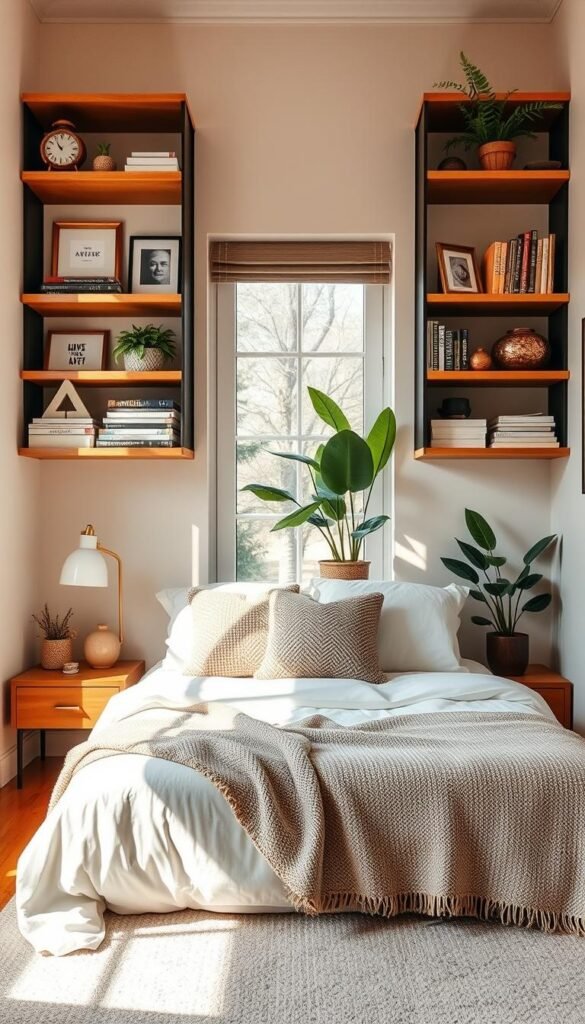
- Best for: a small bedroom with limited wall space where standard shelving would break sightlines.
- Shelf specs: choose 8–10″ depth for books and bins; 12″ max only if brackets and anchors are robust.
- Mounting needs: use stud-mounted brackets when possible; otherwise pick anchors rated to the intended load.
- Practical rule: store lighter, infrequent items up high; keep daily pieces reachable at eye level or lower.
Renter guidance: favor floating shelves with strong anchors and keep total load conservative. Use matching bins to hide contents and reduce visual clutter.
| Pick | Load Rating | Depth |
|---|---|---|
| Shallow profile floating shelves | Up to 25 lb | 8–10″ |
| Heavy-duty bracket kits | 50–120 lb | 10–12″ |
| Long-span wall rails | Variable (anchored to studs) | 10–14″ |
For more ways to hide storage while keeping the floor clear, see storage ideas for tight rooms.
Space Saver: Use Roman Shades to Reduce Window Bulk
Switching to a sleeker window covering immediately clears visual weight from the wall and opens the plan.
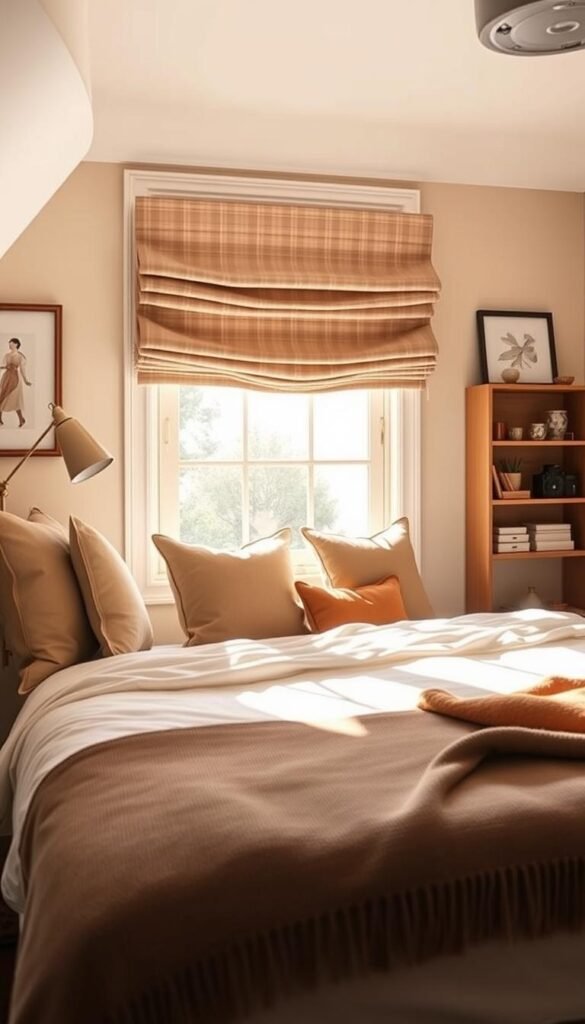
Problem it solves: Heavy drapes often crowd the window area and eat into usable inches. That fabric can make the room feel tighter and block access to bedside surfaces, radiators, or trim.
Why Roman shades help
Designers note that Roman shades sit close to the glass and fold up neatly. Their slim profile keeps the silhouette clean so the room feels larger and less cluttered.
Best for
Ideal for compact rooms where every inch around windows matters for nightstand placement, bed clearance, or radiator access.
Buying considerations
- Inside-mount vs outside-mount: choose based on trim depth and how much overlap is needed for light control.
- Blackout lining: important for sleep and light management.
- Cordless options: safer for households with kids and offer a tidier look.
„Roman shades can add color or pattern without the bulk of full drapery.“
Pros: tidy profile, easier window access, and less fabric in tight corners. Cons: less soft, draped drama and sometimes weaker at hiding off-center windows than full-width curtains.
Decision tip: If the main pain point is tightness around windows, Roman shades are often the better way to make the room feel larger; revisit full-width drapery when the goal is a cocooned, softened backdrop.
Comparison Tables: Quick Picks by Small Bedroom Problem
Use these quick comparisons to pick the right solution for the room’s biggest pain point. Identify whether the main constraint is floor space, storage, light, or how the room feel, then scan the matched table for tradeoffs and buying cues.
Reclaiming floor space: Murphy bed vs daybed
| Problem → Best options | Murphy bed | Daybed |
|---|---|---|
| Daily footprint | Folds away to free most floor space | Permanent footprint but doubles as seating |
| Ease of switching modes | Quick tuck; may need stable wall mounting | Always ready for seating; sleep mode is immediate |
| Install complexity & budget | Higher install cost; professional fit often needed | Lower cost; simple delivery and setup |
| Best for | Studio dwellers, multiuse rooms | Renters wanting seating + guest sleep |
| What to measure | Wall width, stud placement, ceiling height | Room circulation and sofa-scale clearance |
More storage: storage bed vs high shelves vs wall systems
| Problem → Best options | Storage bed (pop-up) | High shelves | Wall systems |
|---|---|---|---|
| Capacity | Large hidden volume under mattress | Moderate; good for bins and boxes | Variable; tailored to needs |
| Renter-friendliness | Moderate; heavy to move | High with proper anchors | High if modular and removable |
| Visibility | Hidden storage | Open display; needs bins to hide items | Can be closed or open |
| Effort to install | Low–moderate (assembly) | Low–moderate (anchor to wall) | Moderate–high depending on build |
| Best for | Couples with limited closet space | Minimalists & seasonal decorators | Homeowners wanting built-in feel; renters using modular |
| What to measure | Side clearance for lift, mattress weight | Wall height and stud placement | Wall width, airflow (vents), and bracket ratings |
Better light: wall sconces vs layered lamps
| Problem → Best options | Wall sconces | Layered lamps (table & floor) |
|---|---|---|
| Nightstand space impact | Frees surface for essentials | Takes tabletop or floor area |
| Wiring needs | Hardwired or plug-in options | Plug-in; easy to rearrange |
| Flexibility for reading vs ambient | Directional task lighting when adjustable | Easy to layer for mood and task |
| Best for | Renters (plug-in) & couples sharing surface | Anyone wanting simple install and flexibility |
| What to measure | Bedside height and wall clearance | Nightstand footprint and cord access |
Make the room feel larger: low bed frame vs pattern vs reflective finishes
| Problem → Best options | Low bed frame | Pattern-drenching | Reflective finishes |
|---|---|---|---|
| Cost | Low–medium | Low–medium (textiles) | Low–high (mirrors, metallics) |
| Risk level (commitment) | Low; easy to change frame | Medium; harder to undo large textiles | Low–medium; swap mirrors or trays easily |
| Specific room feel effect | Creates height by lowering sightline | Creates cohesion and perceived continuity | Increases brightness and perceived depth |
| Best for | Those wanting height and minimal furniture | Seasonal decorators and maximalists seeking cohesion | Anyone needing more apparent brightness |
| What to measure | Clearance to door swings and side tables | Wall width for continuous patterns | Window positions to avoid glare and reflections |
How to use this: pick the table that matches your primary constraint, weigh tradeoffs, then check the „what to measure“ row before you buy.
For more curated looks and product picks that align with these comparisons, see small bedroom ideas for visual examples and buying cues.
Buyer-Focused Checklist Before You Buy Anything for a Small Bedroom
Before buying pieces, confirm function and flow. This short checklist helps buyers avoid returns and costly mistakes by prioritizing measurements, lighting, and renter rules.
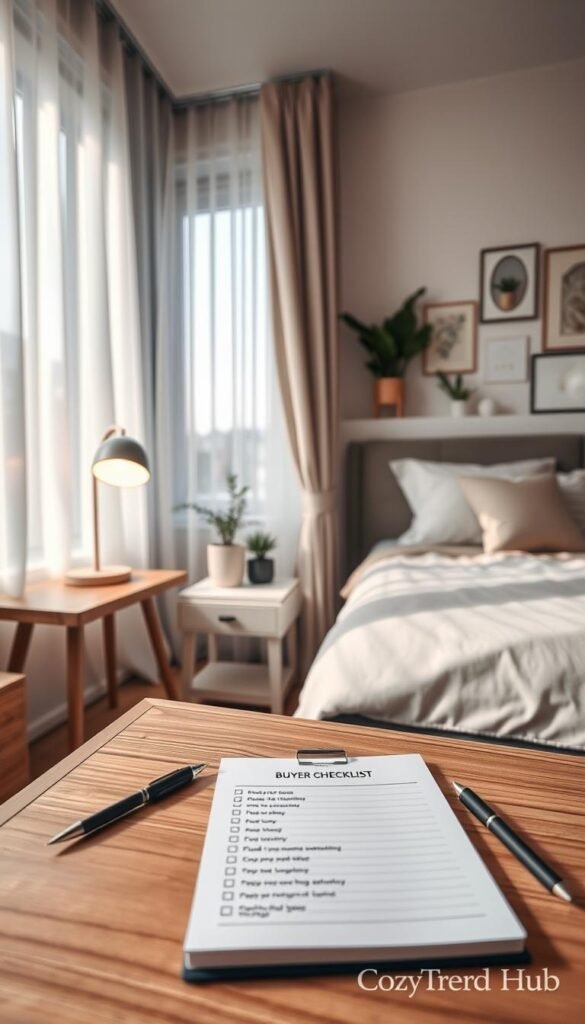
Measure for walking clearance, door swings, and drawer access
Measure the floor plan first. Mark the bed footprint, then add 24–30 inches at circulation points for clear walking paths.
Check door swings and closet reach. Open drawers fully to confirm dressers and under-bed storage will operate without blocking the route.
Pick appropriately scaled rugs and nightstands
A too-small rug or undersized nightstand breaks visual balance. Choose a rug that at least reaches the front two legs of the bed.
Nightstands should fit the bedside scale and let lamps or alarm clocks sit without crowding drawers or tabletop space.
Plan lighting first, then furniture, then decor
Lighting sets function—layer task and ambient sources before committing to large furniture. Wall-mounted options free nightstand surfaces and improve flow.
After lighting, choose the bed and storage. Finish with textiles, art, and soft pieces that support the plan.
Renter-friendly rules: holes, adhesives, and what to save for move-out
Know lease limits for holes. Use removable adhesives rated for the item’s weight and keep patch and paint supplies on hand for move-out repair.
Test layouts with painter’s tape on the floor to confirm clearances before buying large items.
Storage reality check and designer logic
Decide what must be hidden (off-season clothing) versus what can be displayed (books). Match storage to habits to avoid wasted features.
Designer logic: prioritize items that improve sleep, storage, or daily flow. If an item doesn’t, skip it.
| Checklist Item | What to Measure | Action |
|---|---|---|
| Walking clearance | 24–30 in. around bed | Use tape to map paths |
| Door & drawer access | Full swing + drawer depth | Confirm with tape and open test |
| Rug & nightstand scale | Rug reaches front two legs; nightstand height ≈ mattress top | Compare product dims to tape template |
| Lighting plan | Plug access, wall mounting points | Install or mock-up lights before furniture |
| Renter rules | Lease hole limits, adhesive weights | Choose removable solutions; save paint for patching |
For buying basics and furniture essentials that align with these checks, see a practical bedroom furniture essentials guide.
Conclusion
Start by naming the single problem that limits the room most — then fix that first.
Core approach: tackle one constraint at a time — floor space, storage, lighting, or visual clutter. Choose one or two high-impact solutions from the comparison tables and checklist before buying.
Quick recap of design ideas: low bed frames to lift the ceiling, tonal patterns for an illusion, reflective finishes to boost light, dark color for a cocooned feel, and right-scale art to calm the eye.
Top space savers: wall sconces, full-width drapery, extended headboard looks, Murphy beds, and wall or high-shelf storage systems.
Next purchase rule: start with what improves daily use (lighting or access), then add storage, then refine decor. For renter-friendly picks use plug-in lighting and removable wall systems. Use the checklist, measure again, confirm walking paths and drawer access, then choose one idea to implement this week and reassess before buying more.
For minimalist product picks and styling cues, see minimalist bedroom ideas.



2 Comments